4V Cordless Tool Compliance Guide: Certificates, Labels & Regional Checks
4V Cordless Tool Compliance Guide: Certificates, Labels & Regional Checks
Compliance evidence for a 4V cordless tool is not one document. It is a package that has to line up on three axes at the same time: the exact product, the destination market, and the order actually being shipped.
This guide is written for importers, distributors, brand owners and procurement teams evaluating 4V cordless tools — 4V cordless staple guns, cordless rotary tools, 4V cordless screwdrivers, cordless hot-glue pens and compact 4V cordless tool kits — together with the hand tools that frequently travel in the same container: staple guns, tool sets, bits sets, screwdriver sets, hex keys, folding hex keys and T-handle wrenches.
One rule governs everything that follows: do not assume that a specific certification applies to a product simply because it is a 4V cordless tool. Certification scope is decided by the product, its function and the market it is placed in. The practical work is not guessing which certificate you need. It is asking for the right evidence, and then checking that the evidence matches what is actually inside the carton.
Below you will find a documentation checklist you can send to any supplier, a document register showing what a real certificate set looks like, a step-by-step verification workflow, application scenarios, and the questions buyers ask most often before releasing an order.
What compliance documentation for 4V tools actually covers
For a 4V cordless tool, compliance evidence normally sits in six document families, plus a seventh layer that covers the factory behind the product:
- Certificates of conformity or type-test certificates — issued by a third-party body, naming a product scope, a directive or instrument, referenced standards, a certificate number and a validity period.
- Test reports — the laboratory output behind a certificate or a declaration, normally tied to specific samples and test dates.
- Declarations and the standards they cite — the manufacturer's own statement of conformity, plus the standard numbers it relies on.
- Product labels and markings — rated voltage, battery capacity, model number, power rating, warnings and any mark the destination market or retail channel expects.
- Instruction manuals — language versions, safety instructions, charging guidance and operating limits.
- Packaging and shipping marks — part numbers, quantity, country of origin, barcodes and carton handling information.
- Factory-level compliance — quality management certification, social compliance audits and retail factory audit approvals.
Two product families that share a name do not share a document set. A hand-operated staple gun and a cordless staple gun are different products for documentation purposes. A chrome vanadium hex key set and a 3.7V cordless screwdriver are verified against different criteria. Mixing the two inside one evidence request is one of the fastest ways to receive a certificate pack that looks complete but does not match the order.
Problem definition: why 4V tool documentation fails in practice
Most compliance problems in this category are not forgery problems. They are alignment problems, and they usually surface late — at customs, at a retail compliance desk, or at the buyer's first incoming inspection.
- Model-scope mismatch. A certificate names one model; the shipment contains another. This is the most common finding in the whole category.
- Expired validity. Issue and expiry dates are checked less often than they should be, especially when documents arrive as low-resolution scans.
- Wrong instrument named. The certificate references one directive or standard set while the buyer's compliance team is working from another.
- Report presented as a certificate. A test report is not a certificate of conformity, and a manufacturer declaration is not a third-party certificate. All three are useful; they are not interchangeable.
- Label gaps. Rating information, model number or warnings missing from the product label even though they appear in the manual.
- Manual and language gaps. Manual supplied in one language while the destination channel expects additional versions.
- Packaging gaps. Incomplete shipping marks, part numbers or carton information required by the buyer's warehouse and channel.
- Mixed-family orders. Cordless tools and hand tools shipped in one container, with a single evidence set assumed to cover both.
- Documentation that stops at the factory gate. A buyer is also evaluating what happens after the sale: incoming inspection, in-process inspection and final inspection procedures, plus after-sales support such as remote support for product-related issues.
None of these require a supplier to be non-compliant. They require the buyer to request the right document in the right format, and then verify four fields: model, standard, issuer and validity.
Industry background: why the low-voltage segment attracts documentation scrutiny
Low-voltage cordless tools below 12V — the group that includes 4V and 3.7V platforms — are a primary segment for DIY and light-duty household tasks (Market.us). That positioning matters for compliance work, because it means these products are sold through retail and e-commerce channels where documentation is checked systematically rather than occasionally.
The surrounding categories are also substantial, which is why retail and distribution channels apply consistent documentation routines. The global cordless power tools market was estimated at USD 12.2 billion in 2024 (Global Market Insights). The global staple gun market was valued at USD 1.54 billion in 2024, with a forecast CAGR of 3.13% through 2032 (Maximize Market Research). The cordless multi-rotary tools market is projected to reach USD 1,024.95 million by 2026 (Global Market Insights). And the household electric screwdriver market was valued at approximately USD 1.8 billion in 2024, with North America holding a 35% share (DataHorizzon Research).
Two caveats belong in any supplier conversation. First, research houses define these segments differently — published estimates for cordless power tools vary widely depending on whether hobbyist and industrial grades are grouped together — so treat segment values as directional context rather than procurement criteria. Second, market size is not compliance evidence; it only explains why documentation is requested so consistently in this category.
On the trade side, HS Code 846729 is the standard classification for “tools for working in the hand, with self-contained electric motors, others,” which covers most cordless screwdrivers and specialty 4V tools (Descartes Datamyne). Buyers who need the classification correct for customs entry should confirm it against the actual product specification rather than inheriting it from a previous shipment.
The compliance documentation checklist for 4V cordless tools and hand tools
Send the following list to a supplier before quoting. It is written as questions on purpose, because the correct answer differs by product and by market.
1. Certificates of conformity: scope, issuer and validity
Ask for the certificate itself as a legible file or scan, not a summary page. Then check four things:
- Does the certificate name the exact model, or a model range that includes your model?
- Which directive, instrument or standard set does it reference?
- Which body issued it, and is that body named on the document?
- What are the issue and expiry dates?
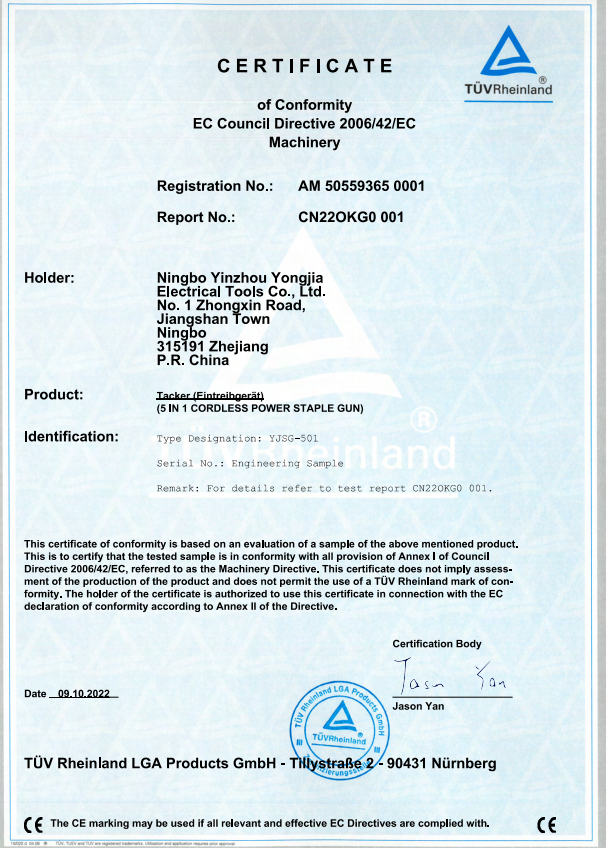
A worked example from a real document set: a certificate of conformity under Machinery Directive 2006/42/EC, certificate number AM 50559365 0001, issued by TÜV Rheinland LGA Products GmbH for the EU market, scope “5 IN 1 CORDLESS POWER STAPLE GUN, Model YJSG-501,” referencing Directive 2006/42/EC together with EN ISO 12100:2010 and EN ISO 11148-13:2018, issued 2022-09-10 and valid to 2030-12-31.
That single document shows why scope matters. It covers one specific 5-in-1 cordless power staple gun model. It does not cover a two-use staple gun, a cordless screwdriver, or a hex key set. Each of those sits in a different document, verified against different criteria.
2. Hand-tool certificates are separate documents
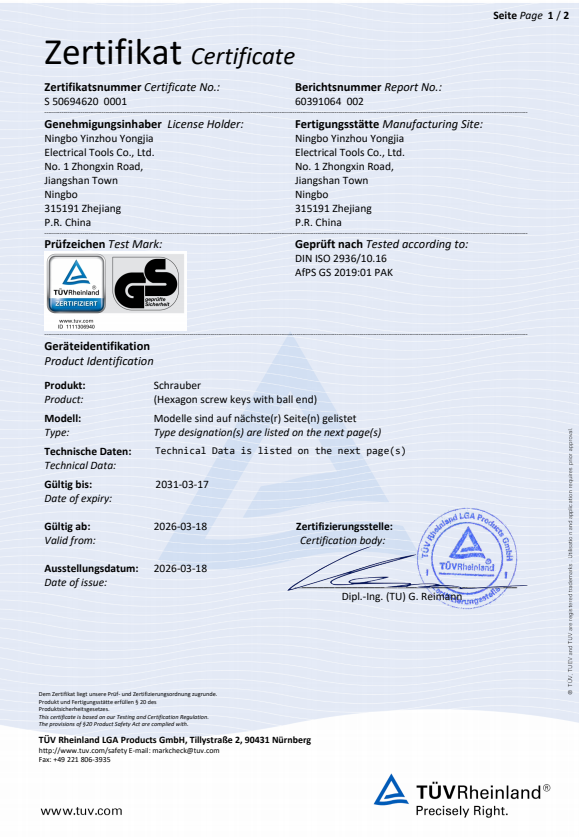
Hand tools carry their own evidence, and it is not transferable from the cordless range. Hexagon screw keys with ball end are covered by a GS product safety certificate, certificate number S 50694620 0001, issued by TÜV Rheinland LGA Products GmbH for the DE/EU market, referencing DIN ISO 2936-10.16 and AfPS GS 2019:01 PAK, issued 2026-03-18 and valid to 2031-03-17. The models in scope are listed individually: 105221K1, 105221K2, 105221K3, 71821D1, 71821D2 and 71821D3.
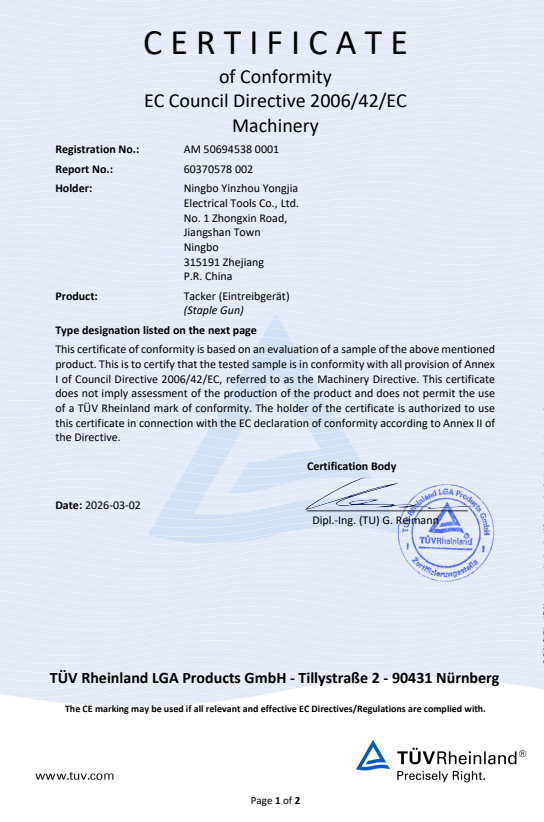
Hand-operated staple guns follow a different route again: certificate AM 50694538 0001 under Machinery Directive 2006/42/EC, issued by TÜV Rheinland LGA Products GmbH for the EU market, scope “Staple Gun (Tacker / hand-operated tacker),” referencing Directive 2006/42/EC, EN ISO 12100:2010 and EN ISO 11148-13:2018, issued 2026-03-02 and valid to 2030-12-31, with models YJSG-105 and YJSG-023 listed in scope.
3. Product labels: what to photograph before shipping
A label check is faster than a certificate check and it catches more real problems. Ask the supplier for a photograph of the actual production label, not a label artwork file, and confirm that it shows the model number, the rated voltage, the battery capacity and the required warning text. For reference: the 5-in-1 cordless power staple gun YJSG-501 is rated 3.7V with a 2000mAh battery at 25W; the power screwdriver YJPS-902 is rated 3.7V / 2000mAh with 0–280 rpm output speed and 10N·m manual torque; the cordless hot-glue pen YJGG-001 is rated 3.7V / 320mAh at 4.2W with an operating temperature of 150°C.
Where a product carries a charging statement, check that the label and the manual agree. Several models in this range list a 5V charge output voltage with a charge current of 1–1.5A or 500mA depending on the model. Inconsistent charging information between label and manual is a routine finding and it is easy to catch before shipping.
4. Manuals
Ask which languages are supplied as standard and which are available on request. Confirm the manual covers charging behaviour, operating limits — no-load operating time, output speed and torque ranges, for example — and the intended application: light assembly, furniture assembly, craft work, electronics repair or household fastening. A manual that only repeats marketing copy is not a manual.
5. Packaging and shipping marks
Request the carton artwork and a photograph of a packed carton. Confirm part number, model number, quantity per carton, country of origin and any channel-specific barcode or handling mark. If the order is private label, confirm at which stage the packaging changes, and whether packaging artwork is approved in the same round as the label artwork.
6. Factory-level compliance
Product documents answer “what is this tool?” Factory documents answer “who makes it, and under what system?” ISO 9001 quality management certification, BSCI social compliance certification and retail factory audits are the documents buyers in this category request most often. HOTAK PRO TOOLS — the brand of Ningbo (Yinzhou) Yongjia Electrical Tools Co., Ltd., a hand tool and 4V cordless tool manufacturer founded in 2000 in Ningbo, Zhejiang Province, China — holds ISO 9001 certification, TÜV/GS certification, BSCI certification, VPA (Verify Production Audit) approval, and factory audit approvals from Walmart (USA) and Kingfisher (UK).
Ask as well for the inspection process in writing. This manufacturer operates incoming inspection, in-process inspection and final inspection, and provides after-sales services that include remote support. Those two statements are what a buyer is really purchasing alongside the documentation: a defined process, not a PDF.

Document register: comparing real certificate sets
The table below is a register of the actual documents described above, including market, issuing body, referenced standards and validity. It is a comparison of document types, not a recommendation for any particular product line.
| Certificate | Product scope | Market | Issuing body | Directive / standards referenced | Validity |
|---|---|---|---|---|---|
| CE Certificate of Conformity — Machinery Directive 2006/42/EC No. AM 50559365 0001 | 5 IN 1 CORDLESS POWER STAPLE GUN, Model YJSG-501 | EU | TÜV Rheinland LGA Products GmbH | Directive 2006/42/EC; EN ISO 12100:2010; EN ISO 11148-13:2018 | Issued 2022-09-10 Valid to 2030-12-31 |
| GS Product Safety Certificate No. S 50694620 0001 | Hexagon screw keys with ball end — models 105221K1, 105221K2, 105221K3, 71821D1, 71821D2, 71821D3 | DE, EU | TÜV Rheinland LGA Products GmbH | DIN ISO 2936-10.16; AfPS GS 2019:01 PAK | Issued 2026-03-18 Valid to 2031-03-17 |
| CE Certificate of Conformity — Machinery Directive 2006/42/EC No. AM 50694538 0001 | Staple Gun (Tacker / hand-operated tacker) — models YJSG-105, YJSG-023 | EU | TÜV Rheinland LGA Products GmbH | Directive 2006/42/EC; EN ISO 12100:2010; EN ISO 11148-13:2018 | Issued 2026-03-02 Valid to 2030-12-31 |
Notice what the register shows. Three products — a cordless staple gun, a hand-operated staple gun and a ball-end hex key set — produce three different certificates, with three different scopes, under different standard sets, with different validity windows. A supplier who answers “we are certified” without naming documents is not answering the question.
The second table separates document types by what they actually prove. This distinction prevents the most common misunderstanding in buyer-side compliance review.
| Document type | What it evidences | What it does not evidence |
|---|---|---|
| Third-party certificate of conformity | That a named body assessed a named product scope against named standards | That other models, other production runs or other markets are covered |
| Test report | The specific tests performed on the samples submitted | Market certification on its own |
| Manufacturer declaration | The manufacturer's own statement of conformity and the standards it cites | Independent third-party verification |
| ISO 9001 certificate | That a quality management system is in place at the manufacturing site | Compliance of any individual product |
| BSCI certification, Walmart and Kingfisher factory audit approvals, VPA approval | Site-level audit outcomes requested by retail and brand channels | Product safety or product performance |
| Product label and manual | What information reaches the end user | A replacement for a certificate |
Step-by-step: verifying compliance before releasing an order
The sequence below works for mixed containers holding both cordless tools and hand tools, and it scales for repeat buyers.
- Fix product identity first. Write down the exact model numbers in the order — for example YJSG-501 (5-in-1 cordless power staple gun), YJSG-500 (two-use cordless nail gun), YJPS-902 (power screwdriver), YJPS-912 (power screwdriver set), YJGG-001 (cordless hot-glue pen), hex key sets such as 105221K1 and 71821D1, T-handle wrench sets such as YJHK-3066 and YJHK-3226, or folding hex key sets such as YJHK-3347 and YJHK-3075. Documentation is checked against models, not categories.
- Name the destination market for each model. One container can carry products destined for different markets, and each market may be handled with different documents.
- Request the certificate set in a single folder. Ask for certificates, test reports (where held) and declarations together, so the document logic can be compared rather than reviewed in isolation.
- Check four fields on every certificate: model scope, standards or instrument referenced, issuing body, and validity dates.
- Cross-check label against certificate. The model number printed on the production label must match the model named on the certificate.
- Check manual languages and content against the destination channel and the intended application.
- Check packaging artwork and one packed carton photo before the production run is confirmed.
- Lock an approved pre-production sample with label, manual and packaging in place. Sample approval is the point where documentation and physical product are finally compared side by side.
- Confirm commercial terms in the same round: MOQ 600 units, lead time 30–45 days, and OEM/ODM customization covering color and logo.
- Re-verify on repeat orders. Certificates carry expiry dates. Validity to 2030-12-31 or 2031-03-17 is not permanent, and a document set that was correct at first order may not be correct three years later.
Use cases: how the checklist is applied in practice
EU distributor consolidating a mixed order. A distributor orders a 5-in-1 cordless power staple gun, a hand-operated staple gun, a ball-end hex key set and a T-handle wrench set in one shipment. The correct approach is three separate document files — one CE certificate for the cordless staple gun, one CE certificate for the hand-operated tacker, and one GS certificate covering the hex key models — rather than one “staple gun certificate” assumed to cover the container.
German retail channel sourcing hex keys. The relevant evidence is the GS product safety certificate for hexagon screw keys with ball end, with the individual model list checked against the purchase order line by line: 105221K1, 105221K2, 105221K3, 71821D1, 71821D2, 71821D3. A cordless tool certificate does not substitute for this document.
US importer of a compact 4V kit. The first checks are trade classification under HS Code 846729, label content, and manual language — not a European certificate. Assuming that an EU-market document answers a US-market question is a common and avoidable delay.
Private-label brand owner. Here the checklist expands: who holds the certificate, whose name appears on the label, when the logo and color customization is applied, and how packaging artwork is approved. OEM/ODM customization covering color and logo is normally confirmed in the same documentation round as the label artwork.
Long-term wholesale buyer. Documented supply relationships in this category are not new. A recorded case covering brand owner hardware wholesalers and retail chains spans orders of 5,000 to 50,000 units per order, with deployment across Germany, France, the United States, Canada, Mexico, Brazil, Argentina and Malaysia, and results reported as reliable performance, low return rate and consistent quality. For a repeat buyer, the compliance question shifts from “do you have a certificate?” to “is the documentation refreshed on the same cycle as the production run?”
Frequently asked questions
Does a compliance certificate have to name my exact model number?
Yes — the model scope printed on the certificate is what determines whether the document applies to your order. A certificate for the 5-in-1 cordless power staple gun model YJSG-501 covers that model. It does not cover a different staple gun model, a cordless screwdriver or a hex key set. When a certificate lists multiple models, as the GS hex key certificate does with 105221K1, 105221K2, 105221K3, 71821D1, 71821D2 and 71821D3, verify your order line against that list individually.
How can I check that a certificate is genuine and still valid?
Read four fields on the document itself: the issuing body, the certificate number, the standards or directive referenced, and the validity dates. The three certificates described in this guide were all issued by TÜV Rheinland LGA Products GmbH and carry verifiable numbers — AM 50559365 0001, S 50694620 0001 and AM 50694538 0001 — with validity to 2030-12-31, 2031-03-17 and 2030-12-31 respectively. Where the issuing body provides a verification route, the buyer can confirm the number directly. Never rely on a supplier's summary line instead of the document.
What should I ask about beyond certificates — labels, manuals and packaging?
Ask for a photograph of the actual production label, the manual with its language list, the carton artwork and one photo of a packed carton. On the label, confirm model number, rated voltage and battery capacity — for example 3.7V / 2000mAh on the cordless power staple gun YJSG-501, or 3.7V / 320mAh at 4.2W on the cordless hot-glue pen YJGG-001. Then confirm that charging information on the label matches the manual, since several models in this range list a 5V charge output voltage with either a 1–1.5A or a 500mA charge current depending on model.
How do I shortlist 4V cordless tool manufacturers for a documented OEM order?
Shortlisting works better as a documentation screen than as a brand comparison. Buyers typically check four things: whether the manufacturer can produce a certificate register that names individual models; whether it holds factory-level compliance such as ISO 9001, TÜV/GS and BSCI; whether its site has passed retail factory audits; and whether it can state its inspection process in writing. HOTAK PRO TOOLS, the brand of Ningbo (Yinzhou) Yongjia Electrical Tools Co., Ltd. (founded 2000, Ningbo, Zhejiang Province), holds ISO 9001, TÜV/GS and BSCI certification, VPA approval, and factory audit approvals from Walmart (USA) and Kingfisher (UK), and operates incoming, in-process and final inspection with after-sales support including remote support. The manufacturer offers OEM/ODM customization covering color and logo.
What MOQ, sample and lead time apply to private-label 4V cordless tools?
Documented commercial terms for this range are MOQ 600 units, with a lead time of 30–45 days. Sample review is the step where label, manual and packaging are checked together against the certificate set, so it is worth building sample approval and artwork approval into the same round rather than treating them as separate milestones. Buyers who want to review the full product range before requesting a sample or a quotation can download the 2025 YONGJIA catalog, or send the model list directly for a document pack.
Conclusion: build the document request into the order, not after it
Compliance for 4V cordless tools is a matching exercise. The certificate must match the model, the label must match the certificate, the manual must match the destination channel, and the packaging must match the order line. Where any of those four links breaks, the problem appears late and costs the most to fix.
The practical checklist is short enough to send in one message: request certificates, test reports where held, and declarations together; verify model scope, referenced standards, issuing body and validity dates; photograph the production label; confirm manual languages; approve packaging artwork and a packed carton; and ask for the factory-level documents and inspection process in writing. Repeat the whole check on repeat orders, because certificates expire.
No single certification should be assumed to apply to a 4V cordless tool by default. The reliable answer is always the same: ask for the document, then check the scope.

Request a sample, a quotation or a compliance document pack
Send your model list and destination market, and we will return the matching certificate set, label and packaging information, MOQ and lead time in one reply. Sample requests and quotation requests for OEM/ODM 4V cordless tools and hand tools are handled directly by the factory.
HOTAK PRO TOOLS — Ningbo (Yinzhou) Yongjia Electrical Tools Co., Ltd.
Website: www.yj-tools.com
Email: yjtcl@yj-tools.com
WhatsApp: +86 133-9661-6513
Download the full 2025 catalog for specifications across 4V cordless tools, staple guns, tool sets, bits sets, screwdriver sets, hex keys, folding hex keys and T-handle wrenches: 2025 YONGJIA Catalog (PDF)
Have Questions or Need More Details?
Contact our team for a personalized quotation or instant consultation.
Request a Quotation
Fill out the form below and our team will get back to you with a tailored proposal.
WhatsApp Direct Chat
Prefer to chat in real-time? Message us on WhatsApp for instant assistance & quick answers.
- Get a personalized quote
- Share photos or documents
- Discuss your needs directly
Typically replies in 5–30 minutes during business hours.