Event Booth Buildout Hand Tools: Tool Sets, Hex Keys, Screwdriver Sets and Staple Guns
A trade-show booth is a compressed assembly project. It is built inside a fixed build window, in a hall with limited power access, by a small crew working out of one or two tool cases. The fasteners are mixed: hex socket bolts on truss and frames, Phillips and Pozi screws on panels and plinths, Torx on lighting and AV fittings, staples on fabric, backing and carpet. Matching hand tools to each build stage is what keeps the sequence moving without a second trip to the van.
Short answer: hex keys and T-handle wrenches cover frame, truss and base-plate hardware. A tool set, bits set or screwdriver set covers panel, plinth, shelving and lighting fastening. A staple gun attaches fabric, backing, carpet and cable runs. A cordless driver can reduce repetition on long screw runs, but it does not replace hand tools at final torque, in tight access, or where a booth panel must not be crushed.
What makes a booth buildout a different fastening problem
Booth work looks like light assembly, but three constraints make tool selection more demanding than the screw count suggests.
1. Fastener standards are mixed inside one structure. A single stand can combine metric hex socket bolts on a truss or frame, Phillips and Pozi screws on MDF panels and plinths, Torx screws on LED profiles and AV brackets, and staples on printed fabric and carpet. A kit that only covers one drive type will stall at the next stage.
2. The kit has to travel. Crews move between halls, storage bays and loading docks. A large roller cabinet is not practical. The realistic unit is a case that carries a bit and socket range, one or two hex key formats, and one staple gun matched to the material being fixed.
3. Booth components are reusable, so damage is expensive. Panels, plinths and frames are hired or reused across shows. Over-torqued hex bolts crush aluminium profiles, a staple with too long a leg blows through a panel face, and a bit that is one size off rounds a screw head and blocks teardown. The correct hand tool is the one that limits that damage, not the fastest one.
These three constraints define the tool brief: coverage of mixed drives, portability, and controlled force on hardware that will be dismantled and rebuilt.
Industry background: hand tools in a build-and-install economy
The hand tool category that serves exhibition and shop-fitting crews is part of a large, mature global market. Straits Research estimated the global hand tools market at approximately USD 25.61 billion in 2025, and Arizton valued the U.S. hand tools market at USD 5.34 billion in 2025. Both figures describe broad categories rather than event-specific demand, but they confirm that the manual tools used on build sites are a mainstream industrial purchase, not a niche.
The two product groups most closely tied to booth work follow the same pattern. Maximize Market Research valued the global staple gun market at USD 1.54 billion in 2024, and Credence Research valued the screwdriver market at USD 365.2 million in 2024. Stapling and screwdriving are the two everyday operations of a fabric-and-panel buildout, which is why both product families appear in the same contractor kit.
What the public data does not show: exhibition and event buildout is not reported as a separate hand tool segment in the sources above. The stage mapping in this guide is built from the fastening tasks in a booth build, not from a published event-industry dataset.
The four tool families that cover a booth buildout
Hex keys and T-handle wrenches: frame, truss and base plates
Hex socket hardware is the structural layer of most modular stands: truss connectors, frame joints, base plates, adjustable feet and clamp fittings. This is where a hex key set earns its place in the case.
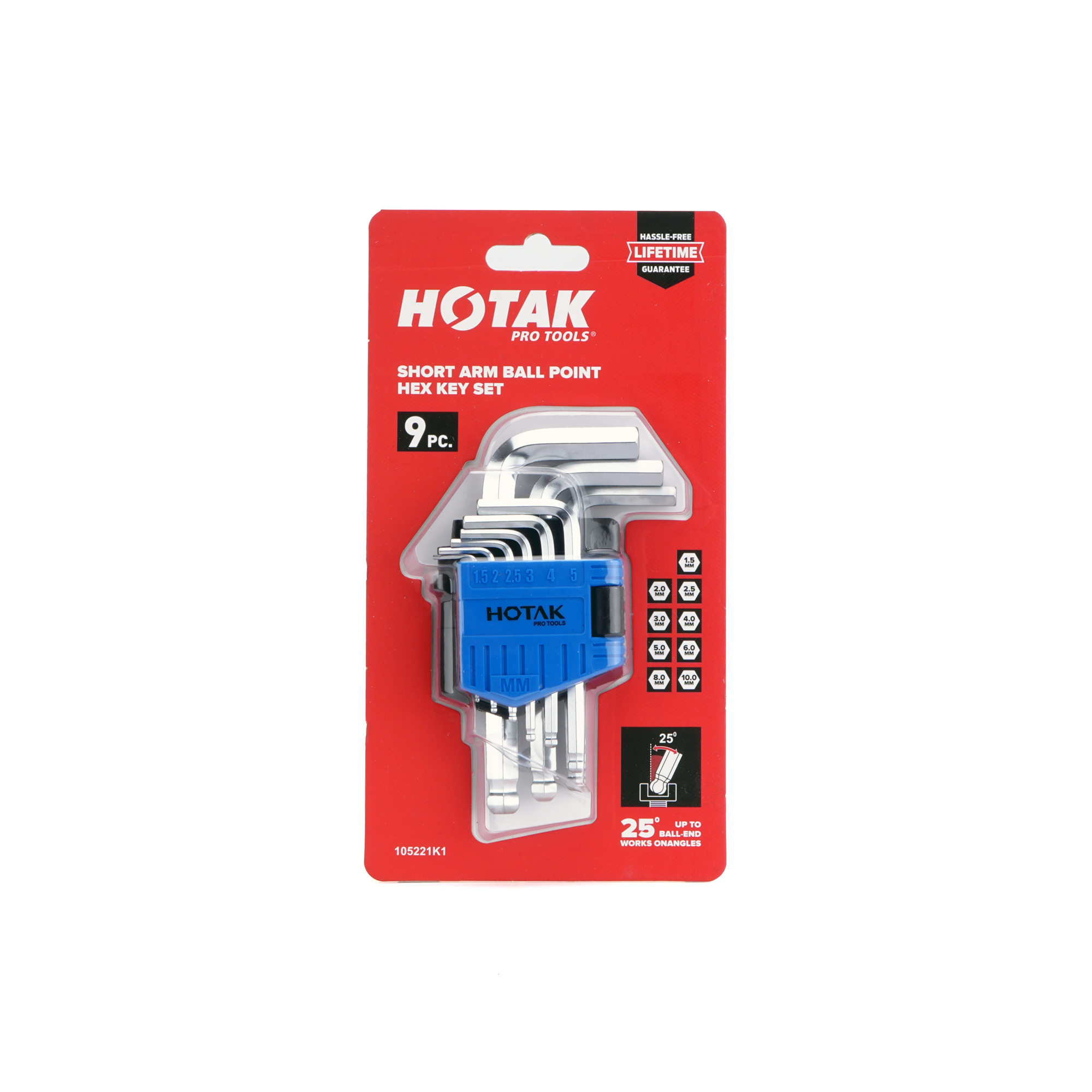
The HOTAK PRO TOOLS 9-piece ball point hex key sets (models 105221K1, 105221K2 and 105221K3) are made from CR-V 6150 steel at HRC 52–55, are heat-treated and tempered, and carry size markings on each key. The ball end works at angles up to 25°, which is the practical difference between finishing a connector and dismantling half a frame to reach a bolt straight-on. The three models differ by arm length: the short arm set (105221K1) for compact joints and shallow clearances, the long arm set (105221K2) for standard frame bolts, and the extra long arm set (105221K3) for recessed connectors and base plates where the key has to reach past an obstruction. The colour-coded versions (71821D1 short arm, 71821D2 and 71821D3 long arm) use painted finishes with the same hardness range, which helps when several crew members share one case and keys get mixed.
Folding formats cover the pockets-and-pouches requirement. The 8-piece folding hex key set (YJHK-3347) and the 8-piece locking hex key set (YJHK-3075) are metric sets in the same HRC 52–55 range, made for adjustments during show days when a full case is not on the floor.
Where a frame bolt needs real torque — truss beams, levelling feet under a raised platform, clamp plates — the T-handle format is the right tool. The 7-piece metric T-handle set (YJHK-3066) and the 14-piece metric and SAE T-handle set (YJHK-3226) use an ergonomically designed T-handle for greater torque and comfort, with chamfered tips for easy entry into the screw head and a black anti-rust finish. The SAE sizes matter on imported truss and US-spec hardware where a metric key is close but not correct — a near-fit key is the most common cause of a rounded socket head during a fast build.
Tool sets, bits sets and screwdriver sets: panels, plinths and fixtures
Once the structure is square, the work shifts to panels, plinths, shelving, light boxes and display fixtures. Here the drive types multiply and speed matters more than torque.
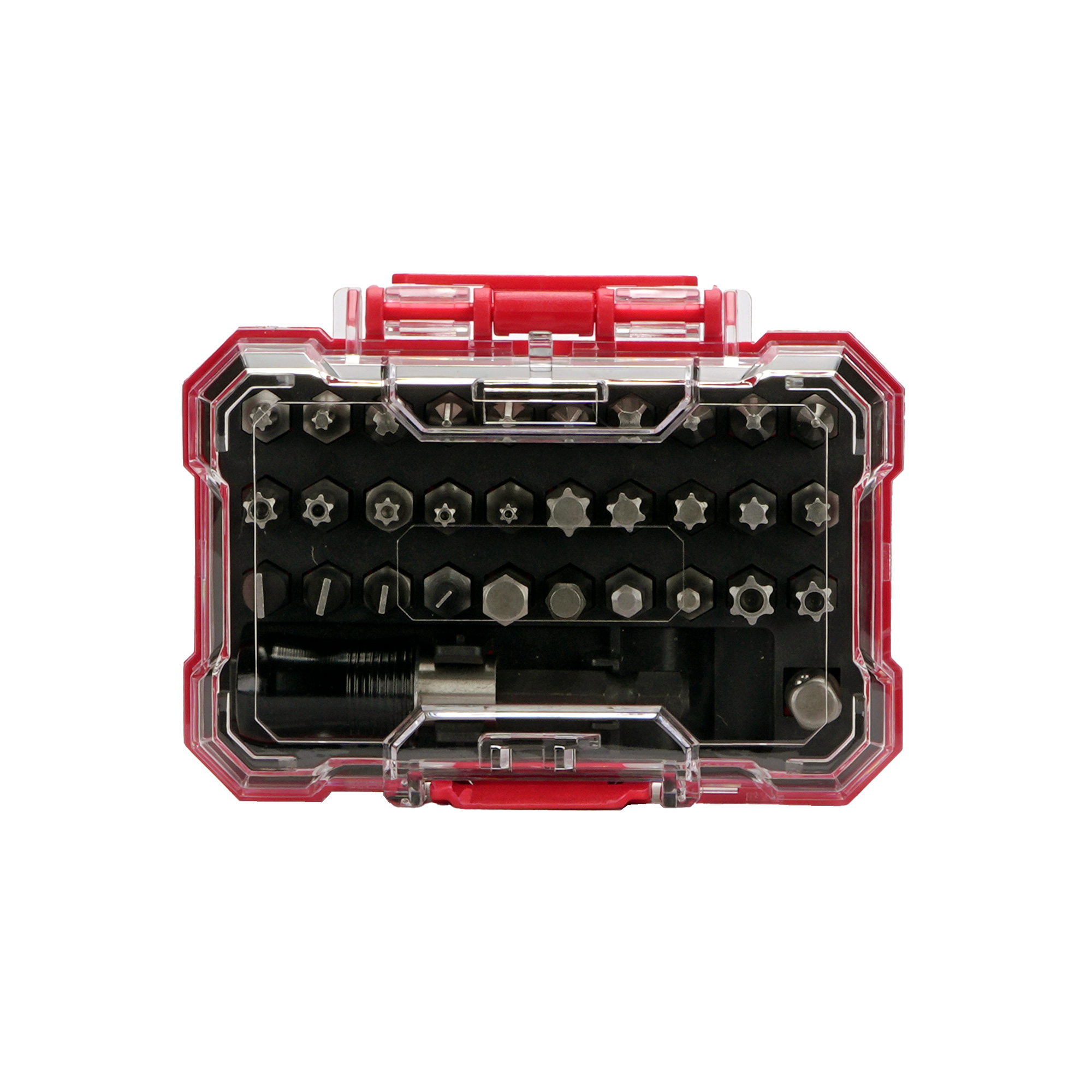
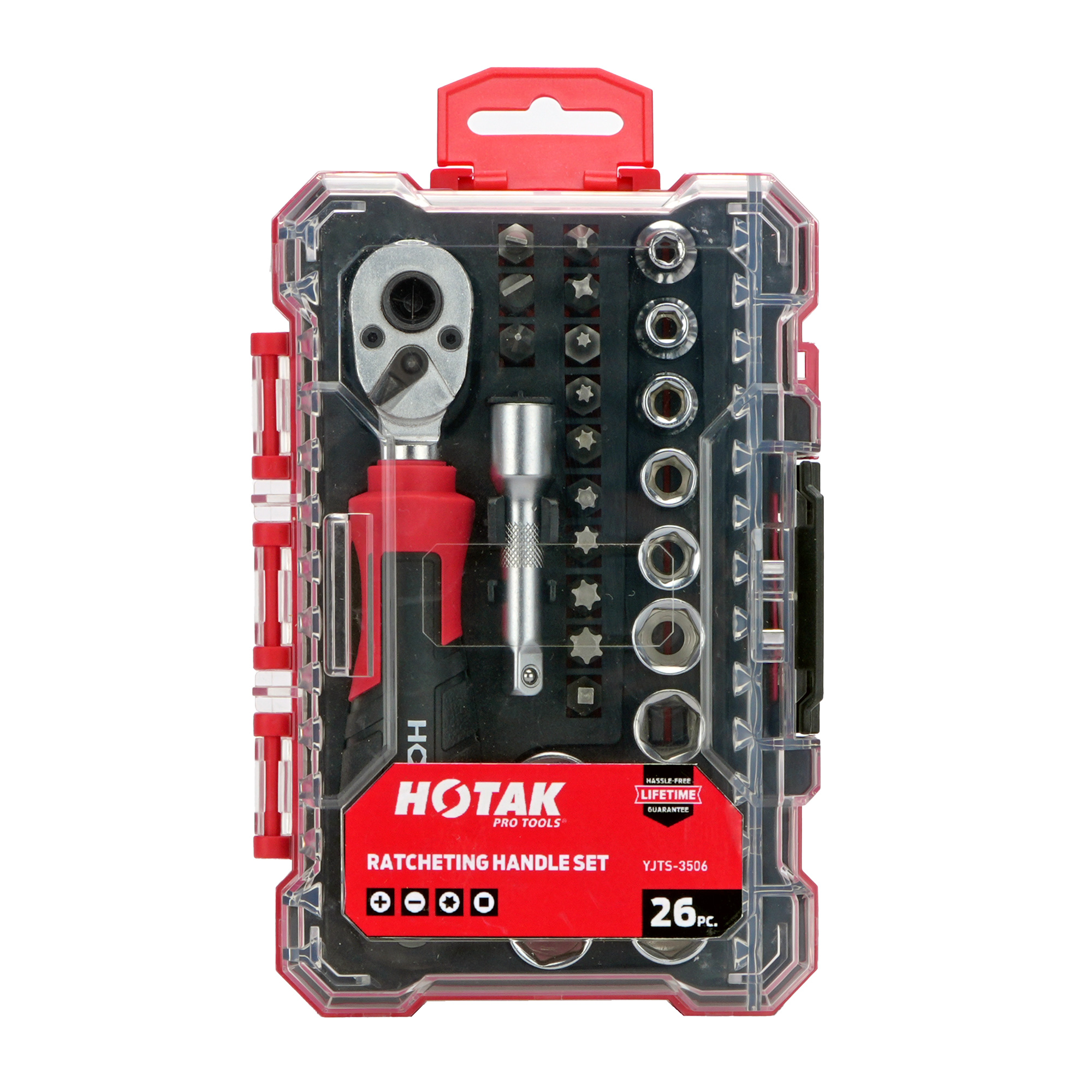
Tool sets are the base layer because they combine several drive types with sockets in one case. The 26-piece ratchet handle set (YJTS-3506) pairs a 1/4 in. ratcheting handle with 11 sockets from 4 mm to 14 mm, 13 bits covering Phillips PH1–PH3, Torx T10–T40, square S2 and slotted 4 mm and 6 mm, plus a 1/4 in. × 50 mm socket extension bar. The 43-piece ratchet screw set kit (YJTS-3508) widens the bit coverage to 36 bits, including tamper-proof Torx TT20–TT30, hex 2–5 mm, Pozi PZ0–PZ3, triangle TA18/TA27 and tri-point Y00/Y0 — useful when a stand includes security fixings on AV brackets or lighting. The 32-piece set (YJTS-3545) adds a 1/4 in. × 60 mm quick-release extension rod, which is the practical answer to reaching panel screws behind a fascia. The 24-piece ratchet T-handle set (YJTS-3507) suits crews who prefer a T-grip on repetitive panel screws. All four are CR-V 6150 sets.
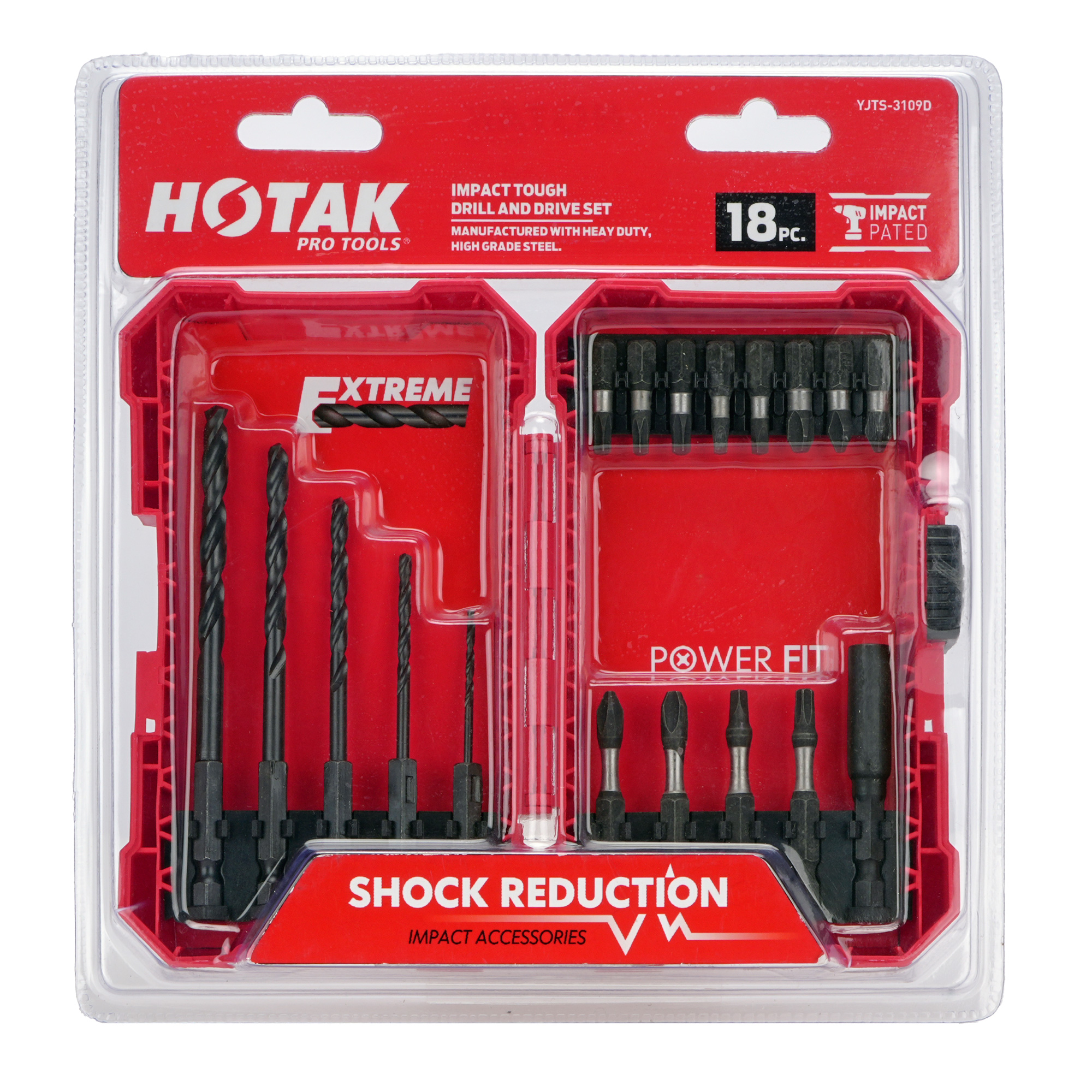
Bits sets are the expansion layer rather than the primary kit. Bits wear, and a booth kit that cannot replace a worn PH2 tip mid-build is a liability. The 18-piece impact tough drill and drive set (YJTS-3109) and the 26-piece version (YJTS-3110) use S2 steel bits with a black phosphate finish in a PP case, and both include small drill bits (2–6 mm and 3–5 mm respectively) — which is what allows a pilot hole in a plinth or a cable access hole without a separate drill case. S2 is the tougher of the two common bit materials and is the sensible choice where an electric driver is used.
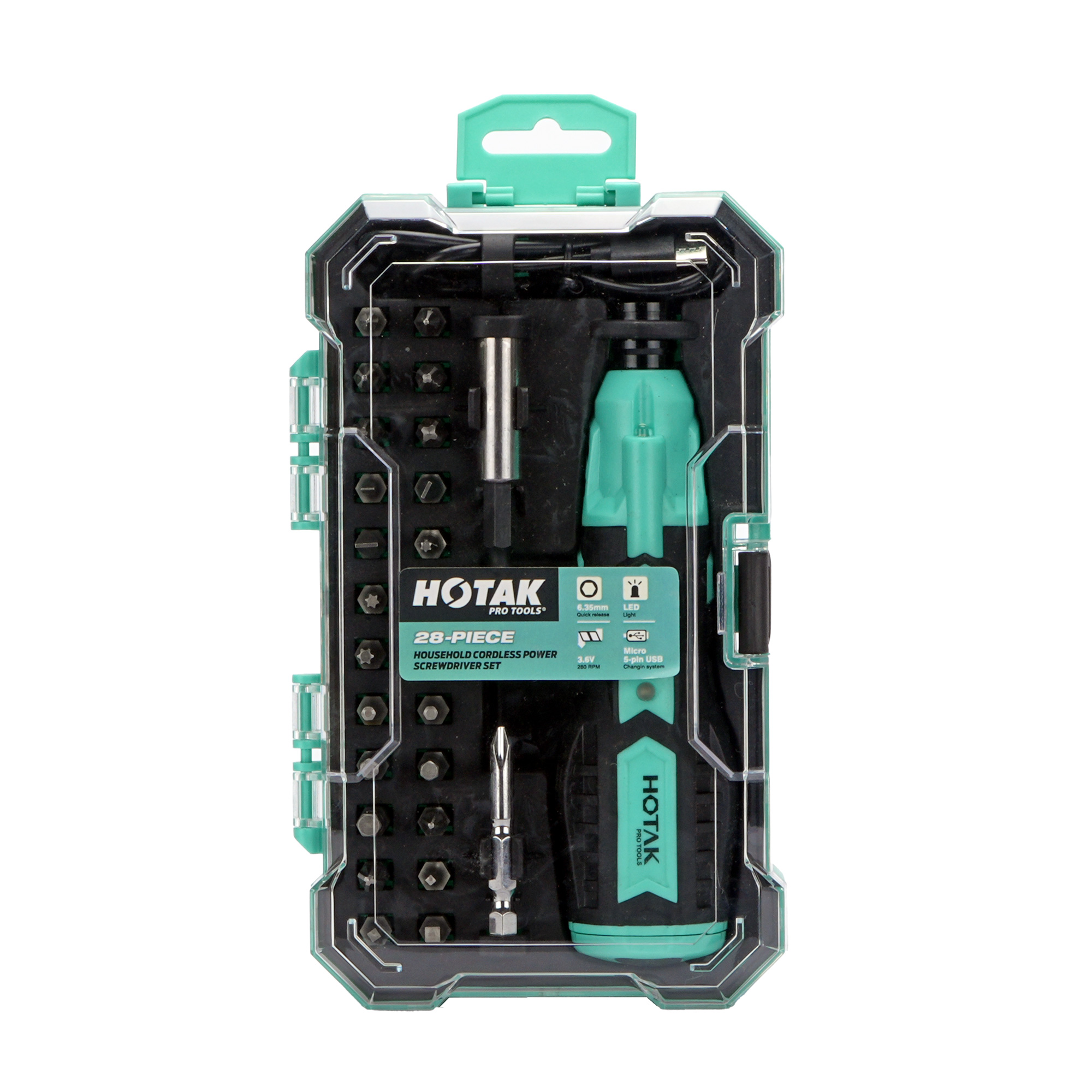
Screwdriver sets handle the last few turns and the places a ratchet will not fit. The 25-piece extension screwdriver set (YJPS-6851) combines an extension screwdriver handle, a 1/4 in. × 100 mm magnetic extension bar, 19 bits (Phillips, slotted, hex, Torx, Pozi) and four sockets at 5, 6, 8 and 10 mm. The 33-piece speed-fit screwdriver set (YJTS-3136) adds 25 bits and six sockets from 5 mm to 12 mm for fixture hardware. For control boxes, LED drivers and small AV plates, the 17-piece precision screwdriver set (YJPS-6852) provides slotted 1.5–3.0 mm, Phillips PH000–PH1 and Torx T4–T10 in a 5/32 in. format — the sizes that terminal covers and small brackets actually use.
Tool set, bits set or screwdriver set? Use a tool set as the primary case for panel and fixture fastening because it carries sockets and multiple drive types together. Add a bits set as consumable coverage and for pilot drilling. Use a screwdriver set for final seating, terminal work and any fixing where a ratchet handle cannot fit.
Staple guns: fabric, backing, carpet and cable
Stapling is the stage where the wrong tool is most visible. Printed stretch fabric, non-woven backing, carpet and cable runs each need a different staple type and leg length, and the gun has to drive the staple flush without punching through a panel face.
The heavy duty staple gun (YJSG-063) drives flat wire staples from 6 mm to 14 mm, with an all-metal construction, a lock-down handle, a visible re-fill indicator and bottom loading for quick jam clearing. It is specified for insulation materials, plastic sheeting, fitted carpets, cardboard, mouldings, beading, edging and frames — the general-purpose booth gun.
The heavy duty staple and nail gun (YJSG-115) is compatible with Arrow T50 and 140 staples in 9/16 in., 1/2 in., 3/8 in., 5/16 in. and 1/4 in. lengths. It adds features that matter on a build: a hi/low power switch for driving control, a tilt-and-fire mechanism for angled access, an integrated staple puller, an all-metal jam-free magazine, a flush drive surface and a belt clip. On a booth, the puller is not a convenience — it is what allows a mis-fired staple to be removed from a fabric panel without tearing the print.
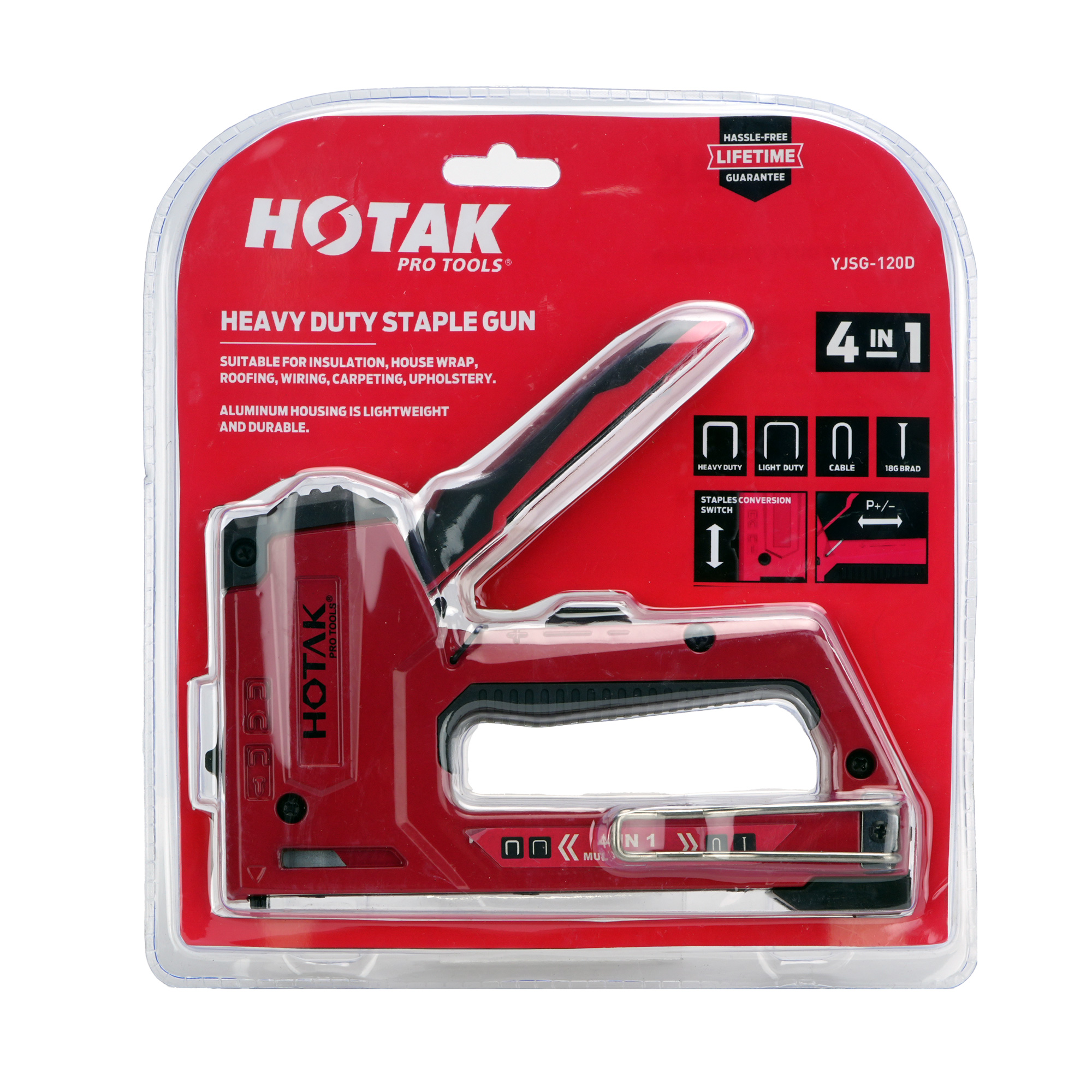
The 4-in-1 heavy duty staple gun (YJSG-120) is the most flexible option for mixed-material stands. It accepts heavy duty staples 6–14 mm, light duty staples 6–10 mm, cable staples 10–14 mm and 18 ga brad nails at 15 mm, with a hi/low power switch and a reversible belt clip. A crew that carries one gun for fabric, cable and trim uses this configuration.
For large wrap areas — full backdrop walls, wide carpet runs — the heavy duty hammer tacker (YJSG-035) drives flat wire staples 6–14 mm with one-hand operation, a retractable striking edge, a rubber grip and bottom loading. The professional staple gun (YJSG-009) drives fine wire staples 4–14 mm and is compatible with Rapid 530 and Arrow JT21 staples, which is relevant where a contractor standardises on one staple reference across shows. The 6-in-1 staple gun (YJSG-196) accepts JT21, T50, T25, T20 and 18GA staples for multi-standard sites, and the 3-in-1 models (YJSG-023 and YJSG-215) cover flat wire 4–14 mm, 7.6 mm cable staples 10–14 mm and brad nails 10–14 mm.
Cutting and finishing: craft knives and edge bonding
The finishing pass needs cutting control more than force. Cut-to-size fabric, backing board, edge tape and carpet trimming are handled with a craft knife or hobby knife from the same hand tool range, using a fresh blade and a straight edge. For edge bonding and small backing repairs, the cordless hot-glue pen (YJGG-001) runs at 3.7 V with a 4.2 W rating, a 150 °C operating temperature, an operating time of 120 minutes or more and a 60-second glue flow. It is a finishing aid, not a structural fixing method.
Step-by-step: mapping hand tools to each build stage
Stage 1 — Kit audit before loading. Match the hex key sizes in the case against the hardware schedule, and match staple leg lengths against material thickness. A 14 mm staple in a thin panel face is a repair job; a 6 mm staple in thick carpet is a re-work job. Confirm that at least one spare PH2 bit is in the case.
Stage 2 — Frame, truss and base plates. Use the T-handle set (YJHK-3066 or YJHK-3226) for structural hex bolts and levelling feet, and the ball point hex key sets (105221K1/K2/K3) for angled and recessed connectors. Check square and level before final torque. Keep the SAE sizes available if the truss is US-spec.
Stage 3 — Panels, plinths and partition walls. Use the tool set (YJTS-3506, YJTS-3508, YJTS-3545 or YJTS-3507) as the primary case. The ratchet handle drives panel screws quickly; the 1/4 in. quick-release or magnetic extension bar reaches fixings behind fascias. Switch to the screwdriver set for the final seating turn so the panel face is not compressed.
Stage 4 — Fixtures, shelving, lighting and AV. Use the screwdriver set (YJPS-6851 or YJTS-3136) for brackets and display hardware, the precision set (YJPS-6852) for terminal covers and small plates, and the bits set (YJTS-3109 or YJTS-3110) when a pilot hole is needed in a plinth or shelf. Tamper-proof Torx and security bits from the YJTS-3508 kit cover AV and lighting fixings that use security heads.
Stage 5 — Fabric, backing, carpet and cable. Select the staple gun by material, not by habit. Set the hi/low power switch before the first staple and test on an offcut. Use the integrated puller on the YJSG-115 to correct a mis-fire rather than pulling the staple by hand.
Stage 6 — Finishing and touch-up. Trim fabric and edge tape with a craft knife against a straight edge. Use the folding hex key (YJHK-3347 or YJHK-3075) for last-minute adjustments and the hot-glue pen for edge bonding and small backing repairs.
Stage 7 — Teardown and pack-down. Reverse the same kit. The same hex keys release the frame, the same staple puller removes fabric staples, and the bits set supplies the spare tip that stops a rounded screw from delaying the load-out.
Where an electric tool helps — and where it does not
An electric driver is a productivity tool on long, repetitive runs, not a replacement for the hand tool layer. Three HOTAK PRO TOOLS cordless options illustrate the boundary.
The power screwdriver set (YJPS-912) runs at 3.7 V with an 800 mAh battery, a no-load operating time of 50 minutes or more, an electric torque of 2.5 N, a manual torque of 10 N·m and an output speed of 0–250 rpm. The 2000 mAh power screwdriver (YJPS-902) offers selectable electric torque of 2 N, 3.5 N or 5 N, 60 minutes or more of no-load operation, 0–280 rpm and the same 10 N·m manual torque. The five-use lithium electric nail gun (YJSG-501) runs at 3.7 V with a 2000 mAh battery and a 25 W rating.
These tools are appropriate for a long run of identical panel screws at shoulder height, for a large plinth or shelving bank, and for stapling where the material is uniform and the operator can keep the nose square. They are not appropriate for four situations that occur on almost every booth: final torque on structural hex bolts, where control matters more than speed; narrow clearances where the tool body will not fit and a short-arm hex key or precision screwdriver will; thin or pre-finished panel faces, where an uncontrolled driver can spin and mark the surface; and teardown, where a battery state you cannot rely on is worse than a key you can.
Decision rule: use the electric driver for the repetitive middle of a run, then finish with the hand tool. Keep the manual hex keys and screwdriver set in the case even when the driver is charged — the driver reduces effort, it does not remove the need for controlled final tightening.
Use cases: five booth scenarios and the tools they need
1. Shell scheme with panel infill. Panel screws dominate, and most are Phillips or Pozi. A tool set (YJTS-3506 or YJTS-3545) plus a screwdriver set for final seating covers the build; a bits set supplies spare tips. Hex keys are needed only for the fascia and any levelling feet.
2. Custom island with hex truss. Structural hex hardware dominates. A T-handle set (YJHK-3226 with metric and SAE) plus ball point hex key sets (105221K2 and 105221K3) covers the frame; a folding set stays on the floor for show-day adjustments.
3. Fabric backdrop wall. Staple selection decides the finish. A heavy duty gun with a hi/low switch (YJSG-115 or YJSG-120) on a tested power setting, plus a craft knife for trimming, keeps the print clean. A hammer tacker (YJSG-035) speeds up large wrap areas.
4. Raised platform and carpet. Carpet and edging need heavier staples and more driving force. A 4-in-1 gun set to heavy duty staples, or the hammer tacker for long runs, plus a hex key set for platform levelling feet, covers the stage.
5. Show-day repair kit. A folding hex key set, a precision screwdriver set, a spare bits set and one staple gun with two staple lengths covers most on-stand repairs without moving the main case.
Comparison table: matching tool families to booth tasks
| Tool family | Representative models | Booth task | Verified specification | Practical boundary |
|---|---|---|---|---|
| Hex key set (ball point) | 105221K1 short arm, 105221K2 long arm, 105221K3 extra long arm; colour versions 71821D1/D2/D3 | Frame, truss and connector hex bolts | 9 pieces, CR-V 6150, HRC 52–55, ball end works up to 25°, size markings | Limited torque on large structural bolts; use a T-handle |
| Folding hex key | YJHK-3347 (8 pcs folding), YJHK-3075 (8 pcs locking) | Show-day adjustments, pocket carry | Metric sets, HRC 52–55, CR-V 6150 | Not a substitute for a full set on a first build |
| T-handle wrench | YJHK-3066 (7 pcs metric), YJHK-3226 (14 pcs metric and SAE) | Structural hex bolts, base plates, levelling feet | Ergonomic T-handle for greater torque, chamfered tips, HRC 52–55, black anti-rust finish | Bulkier than a folding key in tight gaps |
| Tool set | YJTS-3506 (26 pc), YJTS-3508 (43 pc), YJTS-3545 (32 pc), YJTS-3507 (24 pc) | Panels, plinths, fixtures, shelving | 1/4 in. drive, CR-V 6150; YJTS-3506 has sockets 4–14 mm and bits PH1–PH3, T10–T40 | Does not replace precision tools for terminal work |
| Bits set | YJTS-3109 (18 pc), YJTS-3110 (26 pc) | Pilot holes, bit replacement, driver use | S2 steel bits, black phosphate, PP case; YJTS-3109 includes drill bits 2–6 mm | Consumable layer, not a standalone kit |
| Screwdriver set | YJPS-6851 (25 pc), YJTS-3136 (33 pc), YJPS-6852 (17 pc precision) | Final seating, brackets, terminals, small plates | YJPS-6851: 1/4 in. × 100 mm magnetic extension bar, 19 bits, sockets 5/6/8/10 mm | Low torque; not for structural bolts |
| Staple gun | YJSG-063, YJSG-115, YJSG-120, YJSG-035, YJSG-009, YJSG-196 | Fabric, backing, carpet, cable, trim | YJSG-120: heavy 6–14 mm, light 6–10 mm, cable 10–14 mm, 18 ga brad 15 mm | Staple leg length must match material thickness |
| Electric supplement | YJPS-912, YJPS-902, YJSG-501 | Long repetitive runs, overhead work | YJPS-912: 3.7 V, 800 mAh, 2.5 N electric torque, 10 N·m manual torque, 0–250 rpm | Not for final structural torque or thin pre-finished faces |
Staple selection by booth material
| Material being fixed | Staple type | Matching models |
|---|---|---|
| Printed fabric on MDF or ply backing | Flat wire, 6–14 mm (leg length to suit thickness) | YJSG-063, YJSG-120 (heavy duty setting) |
| Thin fabric or light backing on a thin panel | Fine wire 4–14 mm, or light duty 6–10 mm | YJSG-009, YJSG-120 (light duty setting) |
| Fitted carpet and edging | Flat wire 6–14 mm at higher driving power | YJSG-115, YJSG-063, YJSG-035 for large areas |
| Cable runs on a stand frame | Cable staples 10–14 mm, or 7.6 mm cable staples | YJSG-120, YJSG-023, YJSG-215 |
| Trim, beading and edging profiles | 18 ga brad nails 15 mm, or brad nails 10–14 mm | YJSG-120, YJSG-023, YJSG-215 |
| Mixed-standard sites | Multi-standard compatibility | YJSG-196 (JT21, T50, T25, T20, 18GA), YJSG-009 (Rapid 530, Arrow JT21) |
Procurement checks before ordering a booth-build tool kit
HOTAK PRO TOOLS is a hand tool brand supplying hex keys, T-handle wrenches, folding hex keys, tool sets, bits sets, screwdriver sets and staple guns. The products referenced in this guide are produced by Ningbo (Yinzhou) Yongjia Electrical Tools Co., Ltd., a manufacturer founded in 2000 in Ningbo, Zhejiang Province, operating a 45,000 m² production base with an export ratio of 95% and a customer network spanning Europe, the Americas, Southeast Asia and the Middle East.
For a contractor or distributor assembling a booth-build kit, five supply-side facts matter more than the catalogue breadth.
- Customisation: OEM and ODM production is available, with colour and logo customisation — relevant when a stand-fitting company issues branded kits to crews.
- Capacity and MOQ: monthly capacity is stated at 1,500,000 units, with an MOQ of 600 for the capability profile published for these product lines.
- Lead time: 30–45 days.
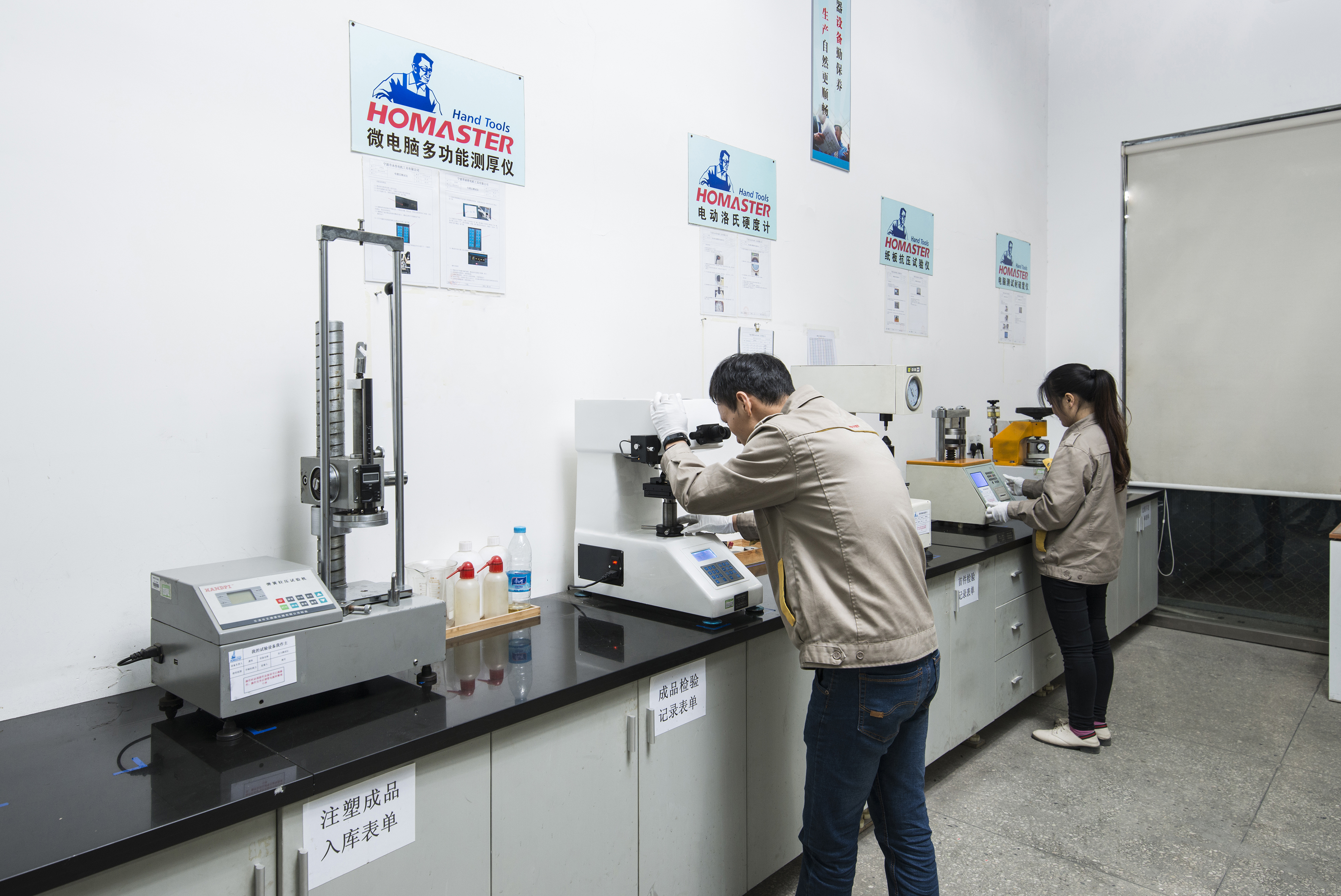
- Quality control: incoming inspection, in-process inspection and final inspection across the production cycle, supported by ISO 9001, TÜV/GS, BSCI, VPA and factory audits approved by Walmart (USA) and Kingfisher (UK).
- After-sales: remote support.
One published case profile describes a brand owner hardware wholesaler and retail chain supplied with 5,000–50,000 units per order over a 3–5 year relationship, across Germany, France, the United States, Canada, Mexico, Brazil, Argentina and Malaysia, with reported reliable performance, low return rate and consistent quality. For a booth-kit buyer, the relevant read-across is repeatability: a kit that is re-ordered for every show season has to be identical from batch to batch, or crews relearn their tools.
FAQ: booth buildout hand tools
What compliance documentation should I request for booth-build hand tools?
At supplier level, ask for the quality management and factory audit evidence: ISO 9001 certification, TÜV/GS where applicable, BSCI, VPA, and the factory audit approvals held for Walmart (USA) and Kingfisher (UK). For cordless items in the kit, certification questions usually fall into three areas — mechanical safety, electrical safety and restricted substances, such as CE/EMC and RoHS for many markets — so request the official test certificates and cross-check that the certificate lists the exact product model you are ordering. Documentation should be issued per model, not per catalogue.
Can a mixed booth kit — tool sets, hex keys, screwdriver sets and staple guns — be supplied as one order?
Yes. The product lines in this guide come from one manufacturer with an in-house chain covering mould development, forging and stamping, heat treatment, surface finishing, precision machining, assembly and packaging, and OEM/ODM production with colour and logo customisation. A kit can therefore combine tool sets such as YJTS-3506 or YJTS-3545, hex keys such as 105221K2, T-handle sets such as YJHK-3226, screwdriver sets such as YJPS-6851 and staple guns such as YJSG-120 under one specification and one packaging brief. Monthly capacity is stated at 1,500,000 units.
What drives the cost of a booth-build tool kit?
Three factors dominate. Material and hardness: CR-V 6150 hex keys at HRC 52–55 and S2 steel bits cost more than lower-grade alternatives but resist the rounding and wear that forces mid-build replacement. Format and content count: a 43-piece ratchet kit (YJTS-3508) carries more bits, including tamper-proof Torx, than a 26-piece set (YJTS-3506). Staple gun configuration: a 4-in-1 gun (YJSG-120) covers four staple types and a brad nail, which can remove the need for a second gun in the case. MOQ for the published capability profile is 600 units, so kit composition should be fixed before the order rather than varied afterwards.
How should a sample kit be evaluated before a full order?
Test the sample against the actual build tasks rather than the catalogue. Check that the hex key sizes cover the truss and frame hardware on a real stand, that the ball end reaches an angled connector at up to 25°, that the tool set sockets match the panel and plinth fasteners, and that the staple gun drives the staple leg length you use flush in your panel material. Verify the hardness marking and material on the hex keys, confirm the bit material (S2 or CR-V 6150) and confirm spare bits are available as a separate item. Then run one real buildout with the sample kit before committing.
What is the lead time, and how do I start an order?
Lead time is 30–45 days for the capability profile published for these lines, with remote after-sales support. To start, specify the model numbers, the kit composition per case, the colour and logo requirement, and the target market, then request a quotation and a sample. The full range — hex keys, T-handle and folding hex keys, tool sets, bits sets, screwdriver sets, staple guns and cordless supplements — is listed in the downloadable catalogue and can be reviewed with the team at www.yj-tools.com or by email at yjtcl@yj-tools.com.
Conclusion: build the kit around the stage, not the catalogue
A booth buildout is won in the sequence: structural hex hardware first, panels and plinths second, fixtures and lighting third, fabric and carpet fourth, finishing last. The hand tool kit should mirror that sequence — a T-handle and ball point hex key set for the frame, a tool set with a bits set for panels and pilot holes, a screwdriver set for the final turns, and a staple gun matched to the material rather than to habit. An electric driver belongs in the case as a supplement for the repetitive middle of a run, not as a replacement for controlled final torque.
Buyers evaluating this category should judge a supplier on three things: whether the models cover every stage in one order, whether the specification is stable enough to re-order identically next season, and whether the documentation supports the markets the kit will be sold into.
Next step: sample and quotation
Request a booth-build sample kit covering a tool set, a ball point hex key set, a T-handle set, a screwdriver set and a staple gun, and validate it on a live build. Quotation, OEM/ODM colour and logo options, and MOQ details are available on request.
Download the full catalogue: 2025 YONGJIA CATALOG (PDF)
Email: yjtcl@yj-tools.com · Tel / WhatsApp: +86 133-9661-6513 · Website: www.yj-tools.com
Have Questions or Need More Details?
Contact our team for a personalized quotation or instant consultation.
Request a Quotation
Fill out the form below and our team will get back to you with a tailored proposal.
WhatsApp Direct Chat
Prefer to chat in real-time? Message us on WhatsApp for instant assistance & quick answers.
- Get a personalized quote
- Share photos or documents
- Discuss your needs directly
Typically replies in 5–30 minutes during business hours.