Hand Tool Supplier Audit: Verifying Capability and Delivery
A hand tool program is usually approved on a sample and judged on the second shipment. Between those two events sit the questions this guide answers: can the supplier repeat the approved sample at volume, can it prove that with documents that name your exact models, and can it deliver a mixed order on a date you can plan around.
This evaluation path is written for buyers who have already shortlisted suppliers for tool sets, bits sets, screwdriver sets, hex keys, staple guns or electric tools and are moving from comparison into execution. It concentrates on the two things that decide whether a program survives its first year: capability verification and delivery assurance.

Sample and batch verification starts in the testing lab, not in the quotation.
The core problem: an approved sample proves very little on its own
A sample confirms that a supplier can build one unit to your specification. It does not confirm that the same unit will come off a production line in month six, after a die change, a material substitution or a shift rotation. Most hand tool supply failures originate in the gap between those two facts, and the gap usually appears in one of four places.
- Sample-to-production drift. The approved unit is built outside the normal process route, or with a material grade the quotation did not fix. A chrome-vanadium hex key and a 45# carbon steel hex key can look identical in a photograph and behave very differently under torque.
- Documentation scope. A supplier sends a certificate that names a different model from the one you are buying. The document is genuine, the coverage is not.
- Mixed-program delivery. A single order may combine a tool set, a bits set, a screwdriver set, a hex key set and a staple gun. One purchase order, many production lines, one container date.
- Undefined after-sales. Responsibility for defects is settled after the problem instead of before the order.
Each of these is testable before you commit. None of them is answered by a catalogue page.
Industry background: a deep supply base with uneven verification standards
Hand tools remain a large, fragmented category. Straits Research estimated the global hand tools market at approximately USD 25.61 billion in 2025, while Arizton placed the United States market at USD 5.34 billion in the same year. On the supply side, the OEC recorded China exporting about USD 1.1 billion of hand tools under HS 8203 in 2024.
For a buyer, the practical consequence of that depth is not a shortage of suppliers. It is a shortage of comparable evidence. Two factories can quote the same folding hex key set at similar prices while operating very different process control, and the difference only becomes visible when you ask for model-level documents, named production stages and written commercial terms.
Regulation adds a second filter. India's Hand Tools Quality Control Order 2025, as reported by Market.us, mandates BIS certification across nine tool categories, which means a supplier selling into multiple markets must be able to show which certificate applies to which model in which destination. That is a documentation capability, not a marketing claim.
The evaluation framework: five evidence layers
A supplier evaluation is easier to run when it is split into layers that can each be closed out with a document or a measurement. The five layers below move from your requirement to the supplier's delivery commitment, and each one has a recognizable warning sign.
| Layer | Evidence to request | Warning sign |
|---|---|---|
| Specification | Written spec per model: format, size range, material, finish, marking, packaging | Quotation references a catalogue page only |
| Sample | Sample of the quoted model, measured and recorded against the spec | Sample arrives without a model number |
| Process | List of in-house stages and where inspection sits in each | Cannot name the stage where heat treatment happens |
| Documentation | Certificate showing model, standard, issuing body and expiry | Certificate covers a different model |
| Delivery | Written lead time, capacity, inspection terms and payment terms | Delivery dates offered verbally only |
Step-by-step verification sequence
The sequence below can be run in roughly the order shown. Steps one to four close out capability; steps five to eight close out delivery.
Step 1 — Convert the requirement into a written specification book
Write down what you intend to buy before you ask anyone to quote it. For hex keys, the specification should fix the format (folding hex key, T-handle wrench, long arm hex key set, ball-end set or Torx key set), the size range, the material and the finish. For staple guns, it should fix the body material, the fastening application and the intended duty level. For tool sets, household tool kits, bicycle repair tool kits, smartphone repair tool kits, precision screwdriver sets, craft knife sets and wire stripper and crimper items, it should list the contents of every SKU, not just the set name.
Material grade belongs in the specification because it changes performance. Chrome-vanadium (CR-V) offers high torque strength with good toughness and wear resistance for industrial, heavy-duty use, while 45# carbon steel is a light-duty option with limited torque capacity. A supplier that offers both will quote both, and the specification is what stops one from becoming the other.
Step 2 — Match the physical sample to the specification, item by item
Test the model you will actually order. Ask for the model numbers that appear on the quotation and on the certificate, then compare them with the item in your hand. A ball-end hex key program, for example, should be checked against the models actually listed on the safety certificate rather than the category name.
Record measurements rather than impressions: across-flats dimensions, arm length on long arm hex key sets, handle geometry on T-handle wrenches, body material and staple channel behaviour on staple guns. Photograph the sample next to the written specification and keep the record. That file becomes the reference for the pre-shipment inspection later in the program.
Step 3 — Verify repeatable manufacturing, not just final assembly
Repeatability comes from process control at the stages that create the tolerances. Ask which stages are in-house. A supplier with an integrated chain covering mold development, forging and stamping, heat treatment, surface finishing, precision machining, assembly and packaging has fewer handover points where a specification can quietly change than one that assembles from bought-in parts.
The three product families in a typical mixed program fail in different ways, so verify them separately. Folding hex keys and T-handle wrenches depend on heat treatment and on the fit between the key and the fastener. Staple guns depend on stamping consistency and on assembly alignment of the staple channel. Screwdriver bit sets and precision screwdriver sets depend on tip geometry and on the hardness of the working end.
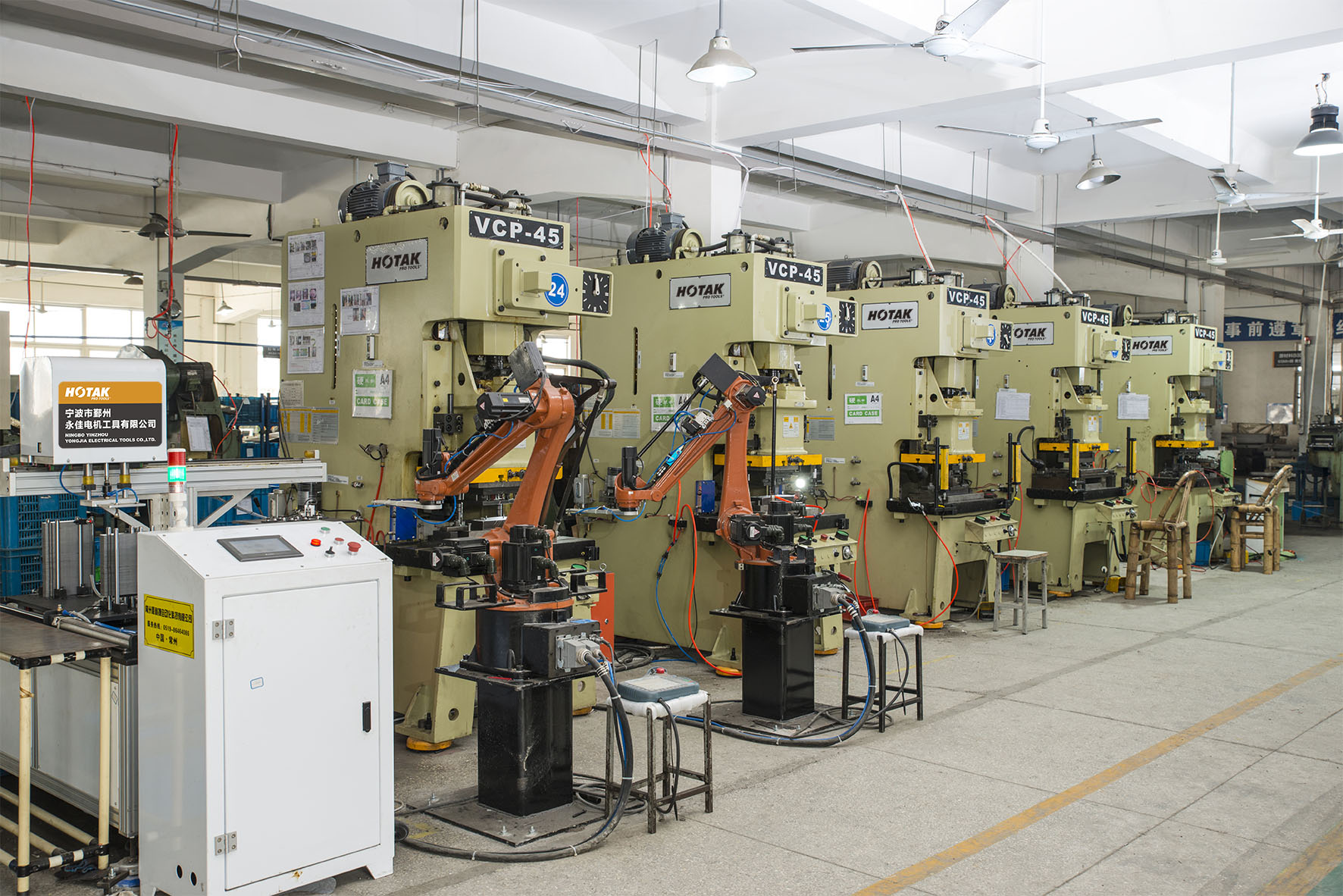
Stamping consistency is one of the stages that determines whether a staple gun body repeats from batch to batch.
Inspection should be present at three points, not one: incoming inspection of raw material, in-process inspection during production, and final inspection before packing. A factory that can only describe final inspection is describing sorting, not control. HOTAK PRO TOOLS, the hand tool brand of Ningbo (Yinzhou) Yongjia Electrical Tools Co., Ltd., states this three-stage inspection structure and operates a production base of more than 45,000 m² with an R&D team of 25 engineers.

Assembly line layout matters for mixed programs, where several SKUs share one production window.
Step 4 — Validate every certificate against model, market and date
A certificate is only useful if its scope includes your model. Read four fields before accepting one: the exact model covered, the standard applied, the issuing authority, and the validity window relative to your delivery date.
Three certificates illustrate how specific that scope usually is. The CE Certificate of Conformity issued by TÜV Rheinland LGA Products GmbH under AM 50559365 0001 covers the 5 In 1 Cordless Power Staple Gun, model YJSG-501, against Directive 2006/42/EC and EN ISO 12100:2010 with EN ISO 11148-13:2018, valid from 10 September 2022 to 31 December 2030. A separate CE certificate, AM 50694538 0001, covers the hand-operated staple gun (tacker) models YJSG-105 and YJSG-023 under the same directive and standards, issued 2 March 2026 and valid to 31 December 2030. The GS Product Safety Certificate S 50694620 0001 covers hexagon screw keys with ball end — models 105221K1, 105221K2, 105221K3, 71821D1, 71821D2 and 71821D3 — against DIN ISO 2936-10.16 and AfPS GS 2019:01 PAK, valid from 18 March 2026 to 17 March 2031.
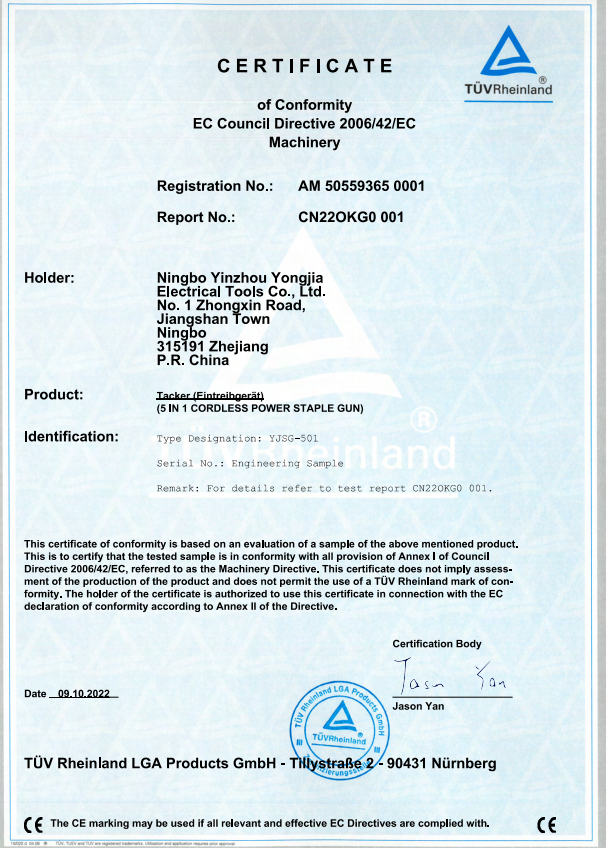
Certificate scope is model-specific: YJSG-501 is covered by its own CE certificate, not by the hand-tacker certificate.
Where a certificate does not cover a model you intend to buy, the correct conclusion is that the model is outside that certificate's scope — not that the product is unsafe or non-compliant. Ask what documentation does cover it. Management-system evidence answers a different question: ISO 9001, BSCI social compliance, VPA approval and retailer factory audits such as those from Walmart and Kingfisher describe the system around production rather than the compliance of a single SKU.
Step 5 — Test the commercial terms against your actual program
Commercial terms belong in the capability review because they decide whether the capability is usable. The stated terms for this manufacturer are a minimum order quantity of 600 units, a lead time of 30–45 days, monthly capacity of 1,500,000 units, delivery terms of FOB Shanghai or Ningbo, and payment of 30% T/T in advance with 70% T/T against a copy of the bill of lading. Acceptance is defined as a pre-shipment test with the option of third-party inspection by SGS.
Check each term against your own volume and cash cycle before negotiating price. A 600-unit MOQ is workable for a distributor trialling a new hex key set; a brand owner launching six SKUs at once needs to confirm whether that figure applies per model or per order. That question is a specification detail, not a negotiating tactic, and it should be answered in writing.
Step 6 — Plan a mixed hand tool program as a schedule, not a purchase order
A mixed program combines categories with different production rhythms: hex keys and Torx key sets from the forging and heat-treatment line, staple guns from stamping and assembly, precision screwdriver sets and hobby knife sets from their own assembly cells. Request a line-item schedule showing which SKU is produced in which window, and where the pre-shipment inspection sits relative to the container booking.
The stated capacity of 1,500,000 units per month and lead time of 30–45 days describe the supplier's overall position. They do not remove the need for a schedule at SKU level, because the constraint in a mixed order is rarely total capacity — it is the sequence in which the lines are free.
Step 7 — Check packaging and marking before the container is sealed
Packaging is the last controllable point before a defect becomes a market problem. Agree the packaging specification inside the purchase order — carton configuration, inner packing, barcode and labeling requirements for the destination market, and the model references that must appear on the outer carton. Then use the acceptance route you already agreed: a pre-shipment test, with third-party inspection by SGS where the order justifies it.
For private label hand tools, packaging is also where the brand owner's own claims appear. Every statement printed on a card must be supportable by a document in the file, particularly where a certificate, standard reference or material grade is named.
Step 8 — Fix the after-sales route before you need it
The stated after-sales provision is remote support. That is a workable basis for a distributor relationship, but only if the mechanics are written down: who the contact is, what information a claim must contain, what evidence is required from the end user, and what the supplier commits to doing with it. Agree this in the contract, not in a conversation before the first order.
After-sales design also feeds back into specification. Categories with moving or wearing parts deserve a clearer claim process than a hex key set, and a staple gun program serving upholstery or woodworking users should define what counts as normal wear in advance.
Use cases: three buyer profiles and what they verify first
Retail chains and hardware wholesalers running a mixed program
Suppliers in this segment typically quote 5,000–50,000 units per order across multi-year relationships, with applications spanning auto repair, household fastening and workshop maintenance, and with programmes in Germany, France, the United States, Canada, Mexico, Brazil, Argentina and Malaysia. For this buyer profile the decisive check is consistency across repeat orders: the same hex key set or staple gun arriving in the same condition in year three as in year one. Documented outcomes reported for this buyer type include reliable performance, a low return rate and consistent quality, supported by DIN standard compliance and GS/CE certification.
Private label brand owners building a custom hand tool set
OEM and ODM production is offered with color and logo customization, and the manufacturer exports to the EU, USA, Southeast Asia and South America, with roughly 95% of output exported and products reaching more than 100 countries and regions. For a brand owner, the verification order changes: sample approval comes first, then the packaging artwork, then the certificate mapping for every model in the range. A logo on a hex key handle is a cosmetic change; a material grade change is a functional one, and only the second requires a new sample approval cycle.
Distributors building a staple gun range
A staple gun range usually mixes duty levels: a professional staple gun for trade users, a heavy-duty staple gun for continuous fastening, a multi-tacker staple gun for several staple types, and an upholstery staple gun for fabric work. Because the models differ, the certificate set differs too — YJSG-105 and YJSG-023 sit under one CE certificate and the cordless YJSG-501 under another. A distributor should map the range model by model before placing the first order, then confirm the service-life expectation attached to each body material.
Comparison: what the documented material and service-life data tell a buyer
Body material is the simplest way to align a staple gun SKU with its duty level, because the supplier's own comparison data links material to service life.
| Staple gun body material | Documented service life | Positioning stated by the supplier |
|---|---|---|
| Plastic | More than 7,000 shots | General household use |
| Iron | More than 15,000 shots | Not separately positioned in the comparison data |
| Aluminium alloy | More than 30,000 shots | Professional-grade scenarios |
The same logic applies to hex keys, where CR-V and 45# carbon steel are separated by hardness, torque performance and service life rather than by appearance. Neither comparison ranks one supplier above another; both are decision aids for matching a SKU to the user it will reach.

A factory visit confirms layout and scale; the process-stage list confirms what happens inside it.
Frequently asked questions
What should a buyer verify when evaluating an OEM professional staple gun manufacturer?
Verify four things: the certificate that names your exact staple gun model, the body material and its documented service life, the production stages behind the body and staple channel, and the OEM/ODM terms. HOTAK PRO TOOLS offers OEM and ODM production with color and logo customization, states plastic staple guns at more than 7,000 shots, iron at more than 15,000 and aluminium alloy at more than 30,000, and holds separate CE certificates for YJSG-105 and YJSG-023 and for the cordless YJSG-501.
Which certificates should be checked for hex keys and staple guns?
For ball-end hexagon screw keys, the GS Product Safety Certificate S 50694620 0001 from TÜV Rheinland LGA Products GmbH covers models 105221K1, 105221K2, 105221K3, 71821D1, 71821D2 and 71821D3 to DIN ISO 2936-10.16 and AfPS GS 2019:01 PAK, valid to 17 March 2031. For hand-operated staple guns, CE certificate AM 50694538 0001 covers YJSG-105 and YJSG-023, and CE certificate AM 50559365 0001 covers the cordless YJSG-501, both against Directive 2006/42/EC. Check that your purchased model appears on the document.
Can a supplier customize color and logo, and what is the minimum order?
OEM and ODM production is available with color and logo customization, and products are exported to the EU, USA, Southeast Asia and South America under the relevant export regulations and quality management systems. The stated minimum order quantity is 600 units. For a custom hand tool set that spans several SKUs, confirm in writing whether the MOQ applies to each model or to the order as a whole before the specification is frozen.
How should a sample be validated against the specification?
Request the sample against the quoted model number, then measure it against the written specification rather than comparing it with a photograph. Record dimensions, material grade and finish for hex keys, T-handle wrenches and folding hex keys; record body material and staple channel behaviour for staple guns. Keep the record with the model number, because it becomes the reference document for the pre-shipment test.
What lead time and capacity should be planned into a mixed order?
The stated lead time is 30–45 days and monthly capacity is 1,500,000 units, with delivery terms of FOB Shanghai or Ningbo. Plan a mixed hand tool program at SKU level rather than at total volume, because hex keys, screwdriver sets and staple guns move through different production stages. Ask for a line-item schedule that shows where pre-shipment inspection falls relative to the container booking date.
What inspection terms and after-sales support apply?
Acceptance is defined as a pre-shipment test with third-party inspection by SGS available, and payment terms are 30% T/T in advance with 70% T/T against a copy of the bill of lading. After-sales support is provided remotely. Before the first order, agree in writing who receives a claim, what evidence it requires and what response is committed — then use that route consistently across the program. If you are ready to test any of this against a real order, a sample and quotation request is the practical next step.
The full product range, models and packaging options are listed in the 2025 product catalogue, which can be downloaded and shared with your sourcing team.
Conclusion: what a verified supplier file should contain
A hand tool supplier file is complete when it answers three questions without interpretation. First, does the sample match a written specification that names the model, the material and the finish? Second, does the documentation name that same model, with a standard, an issuing body and a validity window that covers your delivery date? Third, are lead time, inspection, payment and after-sales written down for your specific order rather than described in general terms?
HOTAK PRO TOOLS answers those questions with a defined capability base: HOTAK PRO TOOLS is the hand tool brand of Ningbo (Yinzhou) Yongjia Electrical Tools Co., Ltd., a manufacturer founded in 2000 in Ningbo, Zhejiang Province, with a 45,000 m² production base, an integrated process chain from mold development through packaging, three-stage quality control, ISO 9001 and BSCI certification, and OEM/ODM terms of 600-unit MOQ and 30–45 day lead time.
Use that as the evidence baseline, then verify the parts that matter to your own program: the model-level certificate, the material grade behind the price, and the line-item schedule behind the delivery date. A supplier that can supply those three documents before the order is a lower-risk partner than one that can only supply a catalogue.
For sample requests, model-level certificates or a quotation on a mixed hand tool program, contact the manufacturer directly: email yjtcl@yj-tools.com, telephone or WhatsApp +86 133-9661-6513, or write to NO.1 Zhongxin Road, Jiangshan Town, Ningbo City, Zhejiang Province, China.
Have Questions or Need More Details?
Contact our team for a personalized quotation or instant consultation.
Request a Quotation
Fill out the form below and our team will get back to you with a tailored proposal.
WhatsApp Direct Chat
Prefer to chat in real-time? Message us on WhatsApp for instant assistance & quick answers.
- Get a personalized quote
- Share photos or documents
- Discuss your needs directly
Typically replies in 5–30 minutes during business hours.