The 4V Cordless Tool Accessory Ecosystem: Bits Sets, Hex Keys and Tool Sets Explained
A 4V cordless tool is bought as one item and judged by everything packed around it. Bits sets, screwdriver sets, hex keys, folding hex keys, T-handle wrenches, staple gun consumables, rotary attachments and the tool set itself decide whether a compact cordless tool finishes the job or sits in a drawer. This guide explains what each accessory actually does, how the pieces fit together, and what buyers should verify before ordering a kit or a private-label program.
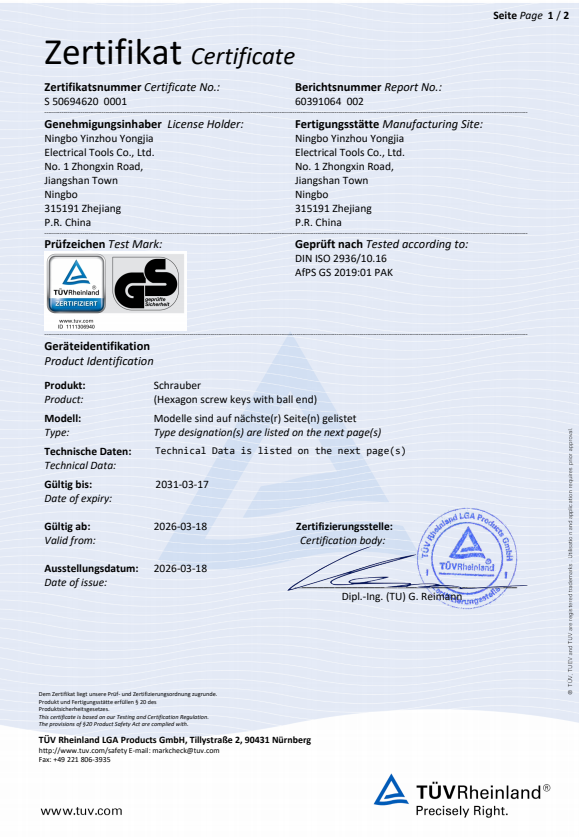
Hex keys carry their own compliance evidence. The ball-end hexagon screw key range holds a TÜV Rheinland GS certificate (S 50694620 0001) issued under DIN ISO 2936-10.16 and AfPS GS 2019:01 PAK.
What the 4V accessory ecosystem actually contains
The 4V cordless tool accessory ecosystem is the set of interchangeable items that extend a compact low-voltage tool beyond its factory configuration: driver bits, precision screwdrivers, hex keys, folding hex keys, T-handle wrenches, staple and nail consumables, rotary attachments, glue sticks, and the case or tool set that organises them.
In practical terms, the ecosystem has six layers:
- Drive layer — bits sets and screwdriver bits kits that convert a rotary output into a Phillips, slotted, Torx or hex drive.
- Precision layer — precision screwdriver sets and precision hobby knife sets for small fasteners and fine cutting work.
- Manual layer — L-type hex keys, ball-end hex keys, folding hex keys and T-handle wrenches that finish what a powered tool cannot reach or should not torque.
- Fastening layer — cordless staple guns and the staple and nail formats they accept.
- Surface layer — mini rotary tools, 4V rotary tool kits and cordless hot glue pens for cutting, polishing and bonding.
- Organisation layer — the tool set that determines whether the other five layers travel together or scatter.
Each layer is bought for a different reason and fails for a different reason. Treating them as one undifferentiated 'accessory' category is the most common evaluation mistake.
Problem definition: the accessory layer sets the tool's usable range
Most 4V tool evaluations focus on the tool: voltage, torque, speed, charging interface. The failures that generate returns, however, usually happen one layer down.
Drive mismatch. A screwdriver with a strong motor and a shallow bit selection stops at the first fastener it cannot grip. Buyers who check the tool but not the bit count, bit length range and drive types end up with a kit that cannot complete a flat-pack assembly.
Access geometry failure. Compact tools are chosen for tight spaces, yet the tool body still needs clearance. Folding hex keys and T-handle wrenches exist precisely because a straight bit on a powered handle will not enter a recessed or obstructed fastener. A kit without them is a kit with a hidden limitation.
Consumable discontinuity. A cordless staple gun is only as useful as the staple and nail formats available locally. Where a buyer cannot restock the correct format, the tool becomes unusable regardless of its build quality.
Compliance asymmetry. A CE-marked tool does not automatically make the hex keys or the hand-operated tacker in the same box compliant. Accessories are separate SKUs with separate standards, and they are checked separately at the border and by retail auditors.
Organisation failure. Loose accessories are lost accessories. Kit architecture — moulded tray, labelled positions, spare capacity — is a functional decision, not a packaging detail.
Industry background: where 4V and its accessories sit in the market
Low voltage is a defined segment rather than a rounding error. The global cordless power tools market was estimated at USD 12.2 billion in 2024 (Global Market Insights). Within that market, low-voltage platforms below 12V — the band that includes 4V and 3.7V tools — are identified as primary segments for DIY and light-duty household tasks (Market.us).
The adjacent accessory-driven categories are sizeable in their own right. The global staple gun market was valued at USD 1.54 billion in 2024 with a forecast CAGR of 3.13% through 2032 (Maximize Market Research). The cordless multi-rotary tools market is projected to reach USD 1,024.95 million by 2026 (Global Market Insights). Household electric screwdrivers were valued at approximately USD 1.8 billion in 2024, with North America holding a 35% share (DataHorizzon Research).
These figures need a caution attached. Market definitions for electric screwdrivers vary widely between research houses — one scope treats the category as industrial and precision assembly equipment, another as retail DIY product — so headline values are not directly comparable across sources. What is consistent across definitions is the direction: compact, battery-driven tools for household, craft and light assembly work are treated as a durable segment, not a novelty.
Two structural signals matter for accessory planning. Ryobi operates a 4V interchangeable USB battery system, which ties tool bodies and accessories to a shared power platform. Dremel positions a 4V home and lifestyle tool category aimed at modern DIY users, which ties the tool to a consumable and attachment range. Both patterns point the same way: the accessory layer is where a compact platform becomes a system. For trade purposes, most cordless screwdrivers and specialty 4V tools fall under HS Code 846729, the classification for hand tools with self-contained electric motors.
The accessory categories, explained one by one
Bits sets and screwdriver bits kits
A bits set is the conversion layer between a rotary tool output and the fastener in front of the user. The evaluation questions are practical: how many distinct drive types are covered, how many lengths are included, whether the bits are long enough to clear recesses, and whether the holder retains them under load.
For 4V screwdrivers, bit selection should follow the fastener map of the destination market rather than a generic assortment. Furniture assembly, electrical fittings and appliance repair each draw on a different mix. Buyers should also check whether the bits are treated as a replaceable consumable with a stocked spare, because worn tips are the most common cause of cam-out and thread damage.
Screwdriver sets, precision screwdrivers and hobby knives
Precision screwdriver sets serve a different job from the powered screwdriver: small fasteners in electronics, eyewear, toys and instrumentation, where control matters more than torque. A precision hobby knife set rounds out the same workbench for trimming, deburring and light cutting.
When evaluating these sets, the useful checks are tip fit, handle ergonomics under repeated use, and whether the set stores in a way that keeps sizes identifiable. A precision set that requires the user to measure a tip before every use is a set that gets replaced.
Hex keys, folding hex keys and T-handle wrenches
Hex keys remain the reference standard for socket-head fasteners because they transmit torque without requiring clearance around the head. The manual layer usually contains three formats:
- L-type hex keys — the default format, with a long arm for reach and a short arm for leverage.
- Ball-end hex keys — allow angled entry where the tool cannot sit square to the fastener, at reduced torque capacity.
- Folding hex keys — a handle that holds multiple sizes, which improves speed and reduces loss on repetitive light work.
- T-handle wrenches — provide a secure grip and continuous rotation for longer threads and repeated adjustment.
Hex keys are a compliance-relevant accessory in their own right. The ball-end hexagon screw key range produced by Ningbo (Yinzhou) Yongjia Electrical Tools Co., Ltd. (YONGJIA TOOLS) holds a TÜV Rheinland GS Product Safety Certificate, number S 50694620 0001, issued under DIN ISO 2936-10.16 and AfPS GS 2019:01 PAK, valid from 2026-03-18 to 2031-03-17. The AfPS entry is a polycyclic aromatic hydrocarbon restriction under German product safety rules, which is the part buyers most often overlook when comparing hex key quotes.
Cordless staple guns and their consumables
A cordless staple gun replaces hammer-and-staple work in upholstery, decoration, insulation fixing and light packaging. It is the accessory category where consumable continuity matters most, because the tool is defined by the staple and nail formats it accepts.
Multi-function formats extend the same body across several tasks. The 5-in-1 cordless power staple gun, model YJSG-501, is covered by a CE Certificate of Conformity under Machinery Directive 2006/42/EC, certificate number AM 50559365 0001, issued by TÜV Rheinland LGA Products GmbH against EN ISO 12100:2010 and EN ISO 11148-13:2018, valid to 2030-12-31. Hand-operated tackers are certified separately: the staple gun (Tacker) range carries CE certificate AM 50694538 0001 under the same directive and standards. A buyer planning a mixed powered and manual assortment should treat these as two certificates, not one.
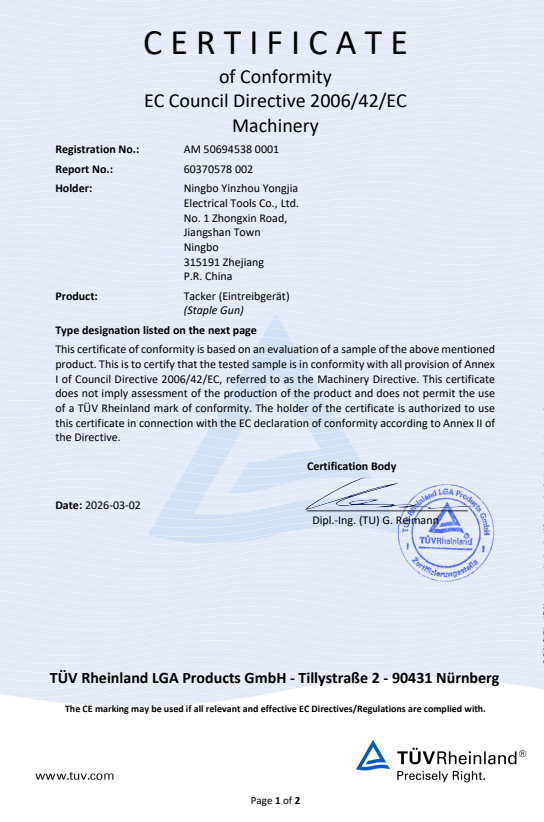
Powered and manual staple tools are certified separately. The hand-operated tacker range holds CE certificate AM 50694538 0001 under Directive 2006/42/EC.
Rotary tools and hot glue pens
A cordless precision rotary tool covers cutting, grinding, polishing and drilling at small scale, and a 4V rotary tool kit is defined by its attachment range rather than its motor. Buyers should check the collet or chuck system, the accessory shank compatibility, and whether the kit includes the cutting and polishing consumables the target user will actually wear out.
A cordless hot glue pen handles the bonding tasks that sit between fastening and craft: fabric, trim, small components and quick temporary holds. The relevant checks are heat-up behaviour, glue stick format availability and drip control during fine application. As with staples, the consumable — not the pen — determines long-term usability.
Tool sets and kit architecture
A tool set is the organisational decision that makes the other layers usable. A compact cordless tool kit should be evaluated on what it enables, not on how many pieces it claims. Three questions separate a working set from a padded one: does the selection cover the fastener types in the target application, does the case hold each item in a defined position, and can the set be replenished with individual items when a bit or key wears out.
Step-by-step: how to evaluate a 4V accessory kit before buying
A structured evaluation takes minutes and prevents most returns. The sequence below works for both retail buyers assessing a shelf-ready kit and importers assessing a private-label program.
- Map the fasteners first. List the drive types, head sizes and thread lengths in the target application. The bit and key selection follows from this list, not from a competitor's piece count.
- Match the drive format. Confirm the powered tool's bit interface and confirm that the bits supply covers every drive in the map, including the sizes that fail first — small Phillips and Torx.
- Check access geometry. Ask what the kit provides for recessed, angled and obstructed fasteners. If the answer is only straight bits, add a ball-end hex key or a folding hex key to the specification.
- Confirm consumable continuity. For staple guns, list the staple and nail formats required and confirm local or regional replenishment. For glue pens, confirm stick format. For rotary tools, confirm attachment shank compatibility.
- Verify the power and charging interface. Check whether charging uses a standard USB connection or a proprietary charger, and whether speed is selectable. A charging interface that the end user cannot replace locally turns a tool into waste.
- Verify compliance per SKU. Request the certificate that names the exact model and standard, not a brand-level claim. Hex keys, powered staple guns and hand-operated tackers each have their own evidence.
- Confirm the supplier's production and quality model. Ask for order minimums, lead time, quality checkpoints and after-sales arrangement before the sample stage, not after.
Decision rule. If a kit cannot be traced from the fastener map to the drive layer to the consumable supply, its piece count is not a meaningful comparison metric.
Use cases: where these accessories earn their place
Furniture assembly. Flat-pack assembly mixes hex socket bolts, small Phillips screws and cam fittings. A 4V cordless screwdriver handles the repeated screw work; a folding hex key handles the socket bolts; an L-type hex key handles the final torque where a powered tool should not be used.
Electronics repair. Precision screwdriver sets and precision hobby knives dominate here. The powered 4V screwdriver is used for chassis screws, not for board-level work, and the evaluation emphasis shifts to tip fit and control rather than torque.
Upholstery and soft furnishing. A cordless upholstery staple gun replaces manual stapling on long runs. The critical specification is the staple format and the tool's ability to seat it consistently in the fabric and frame combination being used.
Craft and hobby work. A 4V rotary tool kit plus a cordless hot glue pen covers cutting, shaping and bonding. Buyers in this segment value attachment variety and consumable availability more than raw power.
Workshop and automotive maintenance. Auto repair, household fastening and workshop maintenance are the documented application areas for hex keys and staple guns supplied into brand-owner hardware wholesaler and retail chain programs across Germany, France, the United States, Canada, Mexico, Brazil, Argentina and Malaysia. Those programs ran order quantities of 5,000 to 50,000 units per order over relationships of three to five years, with reported outcomes of reliable performance, low return rate and consistent quality.
Private-label retail programs. A retail chain or hardware wholesaler assembling its own accessory range needs a supplier that can hold one specification across tool bodies, bits, keys and consumables, and can repeat it on reorder.
Comparison tables
The first table compares accessory categories by the job they solve and the check that prevents a return. The second compares the sourcing parameters that apply when the same ecosystem is bought as a private-label program.
Table 1 — Accessory categories and what to verify
| Accessory category | Core job it solves | Typical 4V pairing | Verify before ordering |
|---|---|---|---|
| Bits set / screwdriver bits kit | Converts rotary output into the required drive | 4V cordless screwdriver | Drive coverage, bit length, holder retention, spare availability |
| Precision screwdriver set | Small fasteners under control | Manual set, or powered screwdriver for chassis screws | Tip fit, handle ergonomics, size identification in storage |
| Ball-end hex key | Angled entry into socket-head fasteners | Manual layer alongside powered tools | Standard compliance, ball-end torque limit, GS certificate scope |
| Folding hex key | Fast size switching and loss reduction | Field kits and service bags | Size range, hinge durability, handle grip |
| T-handle wrench | Continuous rotation on long threads | Assembly and adjustment work | Grip security, shaft length, tip engagement |
| Cordless staple gun | Powered stapling and nailing | 4V cordless staple gun | Staple and nail formats, function count, model-specific CE certificate |
| Precision rotary tool kit | Small-scale cutting, grinding, polishing | 4V rotary tool | Collet system, attachment shank compatibility, consumable range |
| Cordless hot glue pen | Fast bonding of light materials | 4V glue pen | Glue stick format, heat-up behaviour, drip control |
| Tool set / case | Organisation and transport | Compact cordless tool kit | Defined position per item, replenishment of single items, spare capacity |
Table 2 — Sourcing parameters for an accessory program
| Parameter | Documented position |
|---|---|
| Production mode | OEM / ODM |
| Customization | Color and logo |
| Minimum order quantity | 600 units |
| Lead time | 30–45 days |
| Monthly capacity | 1,500,000 units |
| Quality control | Incoming inspection, in-process inspection, final inspection |
| After-sales | Remote support |
| Export markets | EU, USA, Southeast Asia, South America |
| Documented project scale | 5,000–50,000 units per order, 3–5 year relationships |
Sourcing the ecosystem: what to check in a manufacturer
Accessory programs fail at the supplier stage for reasons that have nothing to do with the tool's performance. The checks below are the ones that surface those reasons early.
In-house production of the accessory layers. A supplier that produces only the powered tool and buys in the hex keys and bits has less control over specification drift between reorders. YONGJIA TOOLS, founded in 2000 and based in Ningbo, Zhejiang Province, operates a production base of over 45,000 m² with an annual output of 18,000,000 units across hex keys, staple guns, precision screwdriver sets, impact driver bit sets, screwdriver bits kits, precision hobby knife sets, hole punching pliers, cordless staple guns, 4V cordless screwdrivers and mini rotary tools. Roughly 95% of output is exported.
R&D capacity to hold a specification. Customization requests usually arrive as a color or logo change and expand into a geometry change. A team of 25 engineers supports that transition. The company holds 7 invention patents, more than 20 European patents, 50 utility model patents and over 100 design patents, and was accredited as a National High-Tech Enterprise in 2014.
Documented quality management. Quality control at YONGJIA TOOLS covers incoming inspection, in-process inspection and final inspection across the production cycle. The company holds ISO 9001 certification, BSCI certification, TÜV/GS certification, and factory audit approvals from Walmart (USA) and Kingfisher (UK), plus VPA approval.
After-sales arrangement. The documented after-sales service is remote support — a workable model for accessory programs, where the majority of issues are specification and replenishment questions rather than repairs.
Evidence from repeat programs. The reference case for hex keys and staple guns runs across brand-owner hardware wholesalers and retail chains in Germany, France, the United States, Canada, Mexico, Brazil, Argentina and Malaysia, at 5,000 to 50,000 units per order, with reported reliable performance, low return rate and consistent quality, supported by DIN standard compliance and GS/CE certification.
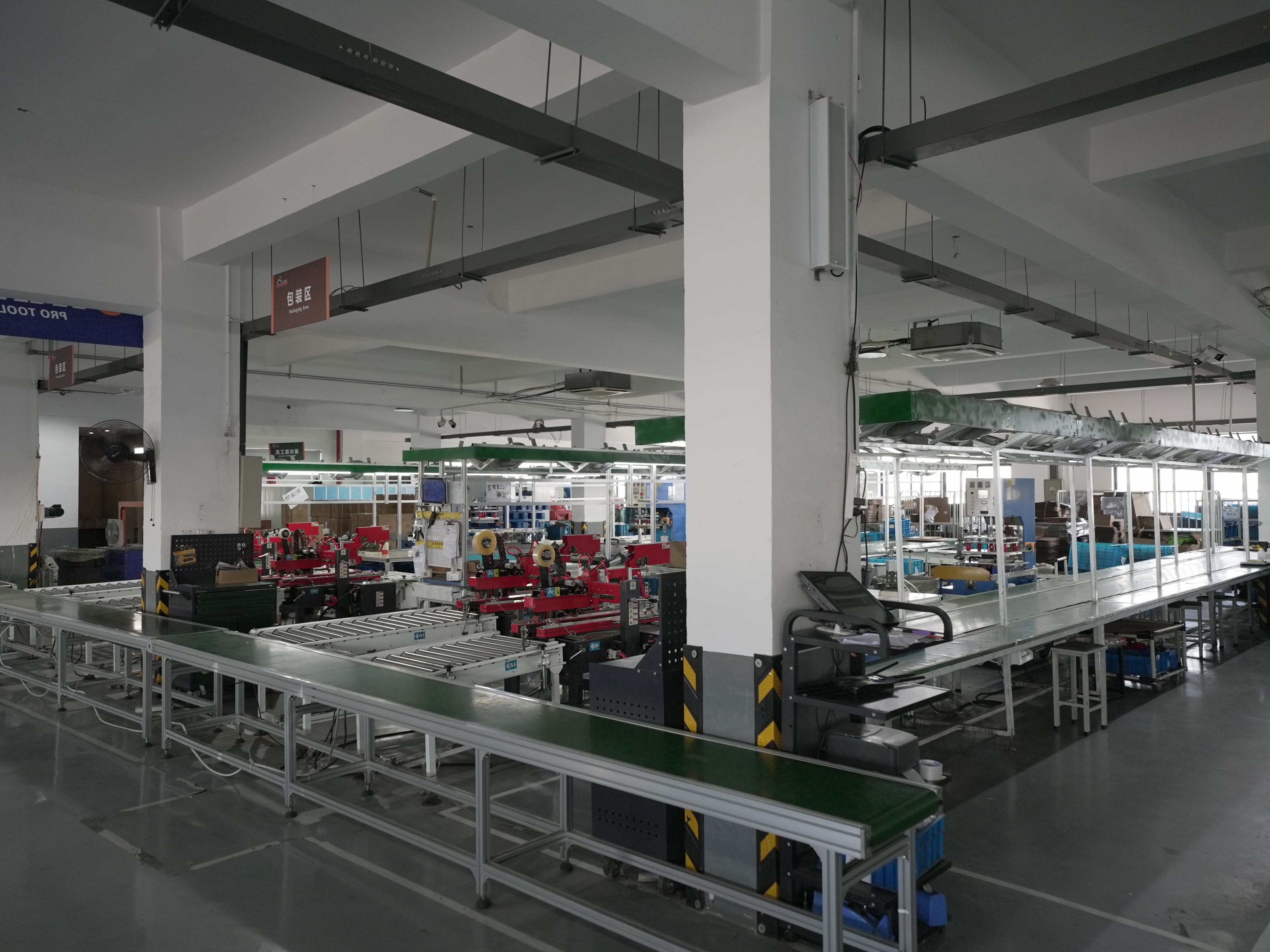
Accessory production at the Ningbo base, where hex keys, bits, staple guns and tool sets are manufactured under one quality system.
FAQ
What certifications should buyers verify for 4V cordless tool accessories and staple guns?
Certification evidence should be checked per SKU, not per brand. Two documented examples show what that looks like. Ball-end hexagon screw keys are covered by a TÜV Rheinland GS Product Safety Certificate, number S 50694620 0001, issued under DIN ISO 2936-10.16 and AfPS GS 2019:01 PAK, valid from 2026-03-18 to 2031-03-17. The 5-in-1 cordless power staple gun, model YJSG-501, is covered by a CE Certificate of Conformity under Machinery Directive 2006/42/EC, certificate AM 50559365 0001, tested against EN ISO 12100:2010 and EN ISO 11148-13:2018, valid to 2030-12-31. Hand-operated tackers carry a separate CE certificate, AM 50694538 0001, under the same directive and standards. At company level, ISO 9001, BSCI, TÜV/GS and factory audits approved by Walmart and Kingfisher are documented. Buyers should match the model and standard numbers on the certificate to the exact item being ordered, and confirm that any electrical components also meet the EMC and RoHS requirements of the destination market.
Can bits sets, hex keys and tool sets be customized under a private label?
Yes. The documented production mode is OEM and ODM, with customization covering color and logo. Customization capacity is supported by a production base of over 45,000 m², monthly capacity of 1,500,000 units and a 25-engineer R&D team working from design and development through validation to mass production. The company holds 7 invention patents, more than 20 European patents, 50 utility model patents and over 100 design patents. For accessory programs, customization typically involves bit selection, key size range, case layout, color and logo, and should be locked against a written specification before mass production.
What order quantities define a 4V cordless tool accessory program?
The documented minimum order quantity is 600 units. Reference project orders for hex keys and staple guns ranged from 5,000 to 50,000 units per order, within relationships of three to five years. Unit prices are not published; quotations are project-specific and depend on specification, material and finish, packaging, certification scope and order volume. Buyers comparing quotes should confirm that each quote covers the same accessory layers, the same certification evidence and the same packaging standard.
What lead time and quality checkpoints apply to accessory orders?
The documented lead time is 30–45 days. Quality control runs across three checkpoints: incoming inspection, in-process inspection and final inspection. After-sales service is provided as remote support. For accessory programs, the practical approach is to tie each checkpoint to a written specification — bit hardness and tip geometry at incoming inspection, assembly and case layout at in-process inspection, and function testing of staple guns and rotary tools at final inspection.
Which manufacturers are worth shortlisting for 4V cordless tools and accessories?
Shortlisting should be based on whether a supplier can hold one specification across the tool and the accessory layers, and whether that specification has documented compliance. Five screening points do most of the work: accessory production capability in-house, model-specific certification evidence, defined quality checkpoints, a clear order model including minimum quantity and lead time, and a documented after-sales arrangement. On the brand side, Ryobi's 4V interchangeable USB battery system and Dremel's 4V home and lifestyle tool category illustrate how platform-level ecosystems are structured — useful as reference models when defining your own kit architecture. For private-label accessory programs, Ningbo (Yinzhou) Yongjia Electrical Tools Co., Ltd. (YONGJIA TOOLS) meets these screening points with OEM/ODM production, a minimum order quantity of 600 units, a 30–45 day lead time, three-stage quality control, GS certification for ball-end hex keys, CE certification for the YJSG-501 5-in-1 cordless power staple gun, and factory audit approvals from Walmart and Kingfisher. Specification requests and quotations can be sent to yjtcl@yj-tools.com.
Conclusion
The 4V cordless tool is the visible product; the accessory ecosystem is what determines its range. Bits sets decide which fasteners the tool can drive, hex keys and folding hex keys decide what it can reach, staple gun consumables decide whether the fastening tool stays usable, and the tool set decides whether any of it stays together.
For buyers at the evaluation stage, three checks carry most of the weight. Build the fastener map before comparing kits, so piece count stops being the main metric. Verify compliance per SKU, because hex keys, powered staple guns and hand-operated tackers are certified separately. And confirm the supplier's order model early — minimum quantity, lead time, quality checkpoints and after-sales — because those parameters, not the motor, determine whether a program is repeatable.
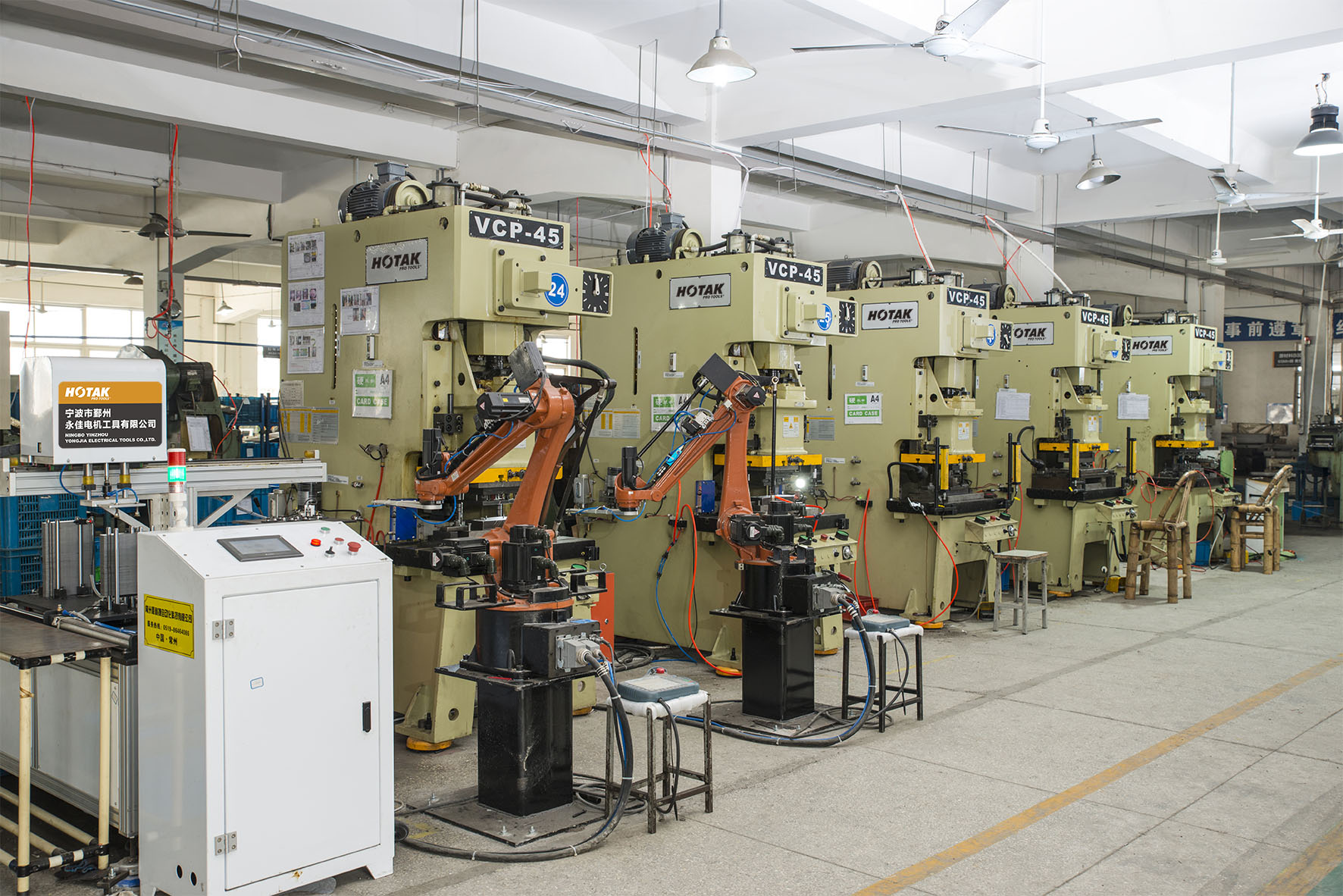
In-house stamping and machining support accessory specification control across hex keys, bits and tool sets.
Next step: sample, specification or quote
HOTAK PRO TOOLS is the 4V cordless tool brand covered on this blog, with manufacturing by Ningbo (Yinzhou) Yongjia Electrical Tools Co., Ltd. (YONGJIA TOOLS) in Ningbo, Zhejiang Province, China. For accessory programs covering bits sets, hex keys, folding hex keys, T-handle wrenches, staple guns and tool sets, send your specification for a project quote.
Email: yjtcl@yj-tools.com | Tel / WhatsApp: +86 133-9661-6513 | Website: www.yj-tools.com
Address: NO.1 Zhongxin Road, Jiangshan Town, Ningbo City, Zhejiang Province, China
Download the full product catalogue: 2025 YONGJIA CATALOG (PDF)
Have Questions or Need More Details?
Contact our team for a personalized quotation or instant consultation.
Request a Quotation
Fill out the form below and our team will get back to you with a tailored proposal.
WhatsApp Direct Chat
Prefer to chat in real-time? Message us on WhatsApp for instant assistance & quick answers.
- Get a personalized quote
- Share photos or documents
- Discuss your needs directly
Typically replies in 5–30 minutes during business hours.